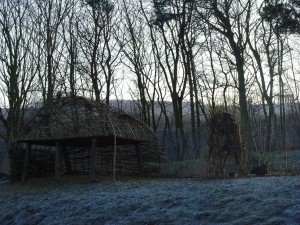
Crane school is a one acre marsh garden at WWT Slimbridge designed to provide crane chicks with everything they need to know about wetland life.
Crane School opened on 3 July with the enrolment of six Eurasian cranes. If these birds pass all of their physical and behavioural exams, when they grow up they will teach other young cranes how to find food and avoid predators before they are released into the wild as part of The Great Crane Project.
Crane school is where young cranes will be taught, by people - staff and visitors, how to be cranes!
Nigel Jarrett is WWT's Aviculture Manager - meaning he is responsible for all the birds at the Trust. Born in a little place near Newcastle some 41 years ago, Nigel has worked at Slimbridge for over 20 years and is the hands-on crane expert for WWT's role in The Great Crane Project. Nigel has a soft spot for cranes because "I love long-legged birds!".
- 5 Oct
5 October 2007
Friday 5 October
This week we had presenter Ellie Harrison from BBC's The One Show back at Crane School to help us with one of the most important lessons of all - how to protect yourself from predators. Although these cranes will never be in the wild, it is vital that they learn how to react to predators so they can transfer that behaviour to their young crane 'pupils' in future years.
To teach them how to respond to the presence of a fox, we use a well trained dog who looks similar to a fox. Tilly's owner is a member of staff here at WWT Slimbridge. To help the cranes with their reactions, we also used a recording of adult cranes to act as an added cue. This was going to be the first time we had attempted this, and we weren't really sure how it was going to go, or even if it was going to work.
As Tilly the dog and her owner entered the marsh garden, the costumed crane keepers (myself, my colleague Susie Dickinson and The One Show's Ellie) raised our litter picker crane heads to the sky and promptly marched off in the opposite direction to the dog. At the same time, we played the recording of the adult cranes and, after looking momentarily confused, right on cue the young cranes followed suit by putting their beaks in the air and running after us away from the dogs to a place of 'safety'. It worked brilliantly and we will perfect this over the next few months.
Post a comment - 14 Sep
14 September
14 September
Now the cranes are pretty much fully grown they need permanent leg rings. Up to now we've fitted them with colour-coded cable ties which we have quickly and easily been able to replace frequently over the last few months as they've grown.
So we are now fitting the cranes with shaped plastic leg rings, each bearing the first four letters of their names, so visitors will easily be able to see who's who.
The school nurse has also been to visit this week. Now the cranes are foraging around for food themselves more and more, there is the danger that they will ingest parasites which won't do them any good at all. So using a dropper tube inserted into their mouths we've given them some worming treatment to keep their digestive systems iin tip top condition.
There's been much speculation amongst the crane keepers about which of the birds are male and which are female. The only way to find out for sure is to DNA test them, so this week we've been plucking a small feather sample from each bird to send off to the lab for sexing. We should know the answers in a couple of weeks or so.
The most subscribed-to theory so far is that Dizzy and Muck are girls - owing to the fact they are slightly smaller and have browner colouring on their heads. Let's see if they're right!
Post a comment - 7 Sep
7 September
The cranes are nearly fully feathered which means that they will soon finish their foundation courses at crane school. Term 1 has focussed on PE (Physical education) and the birds have received daily lessons in basic survival skills, such as hunting for food in and around the School wetlands in all weathers be it rain, hail or shine (but mostly rain!).
Food appreciation classes have also been timetabled throughout the day. It would seem that young cranes like nothing more than to discover, taste, experience and swallow food, especially if it's in the shape of an elver (young eel), a butterfly, or bunch of rosebay willow herb flowers!
Now the summer term nears its end it's appropriate for our term time teachers, Susie Dickinson and Phoebe Young, to compile Crane School Reports for our last two birds...Scrambler
PE: Scrambler is a bouncy character and is always the star of PE lessons, ever ready to prove his strength and speed. His initial fear of water was soon overcome with a little extra tuition - he now bathes at least twice a day!
Food Appreciation: A* - enough said!
Next term: Scrambler is a very quick learner, but as one of the biggest and most dominant birds, he needs to work on his social skills and to stop bulling the smaller birds.
Lofty
PE: Early on, Lofty's sense of balance was affected a little by his inwardly curved right middle-toe - he'd often trip over a blade of grass! As the tallest member of the class this made him appear gawky and graceless. However his 'can do' attitude has allowed him to recover from all his falls to become our most elegant bird - he has a muscular frame with a perfect feather coat!
Post a comment
Food Appreciation: Lofty sets the standard where foraging for food is concerned - he's always first into the muddy margins of the School pool for a 'tug of war' with a root, nearly always following up with a bath!
Next term: Lofty socialises well with the other birds and his quirky character makes him quite a favourite with his tutors - he should do well next term. - 31 Aug
31 August
The cranes are nearly fully feathered which means that they will soon finish their foundation courses at crane school. Term 1 has focussed on PE (Physical education) and the birds have received daily lessons in basic survival skills, such as hunting for food in and around the School wetlands in all weathers be it rain, hail or shine (but mostly rain!).
Food appreciation classes have also been timetabled throughout the day. It would seem that young cranes like nothing more than to discover, taste, experience and swallow food, especially if it's in the shape of an elver (young eel), a butterfly, or bunch of rosebay willow herb flowers!
Now the summer term nears its end it's appropriate for our term time teachers, Susie Dickinson and Phoebe Young, to compile Crane School Reports for two more of our birds...
Dizzy
PE: Dizzy is always excited to be outside and will stays in the School Marsh Garden for as long as she can - at times it's been difficult to persuade her back to the Crane School Dormitories at night-time.
Food Appreciation: Dizzy is the 'loan forager' - quietly enjoying the challenge of finding her own food. Her constant practising has really paid off and she now excels at fly catching, a technique the other birds have yet to master.
Next term: Dizzy is our most independent young crane and with her placid and peaceable nature we expect her to be the unofficial leader of next term's survival skills training.
Muck
PE: Muck should be proud of herself: as the class baby she has had a few challenges to overcome - not least bullying by the bigger boys. This has meant that exercise sessions were sometimes unpleasant experiences for her. However, her recent progress has been astounding - once afraid of being out of her depth she now takes to the School pool like a duck to water!
Post a comment
Food Appreciation: Muck has developed an obsession with eating the pink flowers or rosebay willow-herb. Next term she will be given extra tuition in how to appreciate 'other' foods.
Next term: Muck has had to develop a feisty character to overcome the boisterous attentions of other crane chicks. This should stand her in good stead for next term when social skills training begins.
- 24 Aug
24 August
Until now the young cranes have taken their lessons alone or in pairs - that is, one human teacher (wearing the crane costume) has taken one or two chicks into the Crane School Marsh Garden at a time. We are now about a month away from when the young cranes begin to take their lessons as a group and it so its appropraite for our term time teachers, Susie Dickinson and Phoebe Young, to provide a few carefully-worded comments on each of their pupils! This term lessons have mainly focussed on exercise (Physical Education) and foraging (Food Appreciation). Here's the low down on two of our birds...
Scoop
PE: Scoop has great physical balance. Although always eager to take exercise he often loses interest during warm weather - retiring to his favourite spot among the sweet flag iris where to enjoy the shade. Perhaps this inclination for inactivity led to Scoop developing 'angel wing' half way through the term (see 27 July entry) - too much food and not enough exercise it would seem!
Food Appreciation: Scoop has found some excellent foraging spots in the Crane School Marsh Garden which he doesn't mind sharing with his fellow pupils. Scoop's inquisitive nature has been a real asset to the class - he's a quick learner and is often the first to find new food sources.
Next term: Scoop is a sociable bird and gets on very well with all his fellow pupils. We expect him to be the benchmark student next term when the young cranes take lessons together.
Roley
PE: Bright eyed and excitable, Roley is the class's cry-baby - she's the most vocal of the birds and would do well to stop 'singing' occasionally and take time to look where she's going! That said, she is a pleasure to be with in the Crane School Marsh Garden and will walk, run or swim wherever her teacher leads her.
Food Appreciation: Very dependent on the 'puppet head' to lead her to food, Roley has only just started to forage for herself - better late than never!
Next term: Roley's vocal skills should come into their own next term when the young cranes begin to learn predator avoidance skills - by calling out if danger threatens! Although happy to be part of a group, Roley doesn't find it easy to make friends. This should change next term when the class begin to take group lessons.
Post a comment
- 17 Aug
Friday 17 August
Today we made a video diary to record in moving pictures the daily routine at Crane School. The video link below shows in a minute what it takes over 12 hours to get through! The day normally goes something like this...
7.30am: The Crane School day begins with the dinner ladies preparing food for the crane chicks. This involves dicing carrots, slicing potato, chopping greens and scraping the corn off a cob or two!
8-8.30am: After a night's rest in their dormitories the young cranes are led to the Crane School Marsh Garden to stretch their legs and wings.
8.30am-8.30pm: The next twelve hours are spent taking lessons. At the moment these are based on PE (physical education) and involve lots of walking exercise as the birds search the Crane School wetland for food that has been deliberately hidden by the dinner ladies on land, underground and in the water.
8.30pm-ish: After a quick bathe and shake dry, it's back to the safety of the Crane School dormitories for a good night's kip!
Post a comment - 3 Aug
Friday 3 August
At last, the cranes have names. The ITV competition closed and the winning theme was Bob the Builder - the children's TV show. It's been easy - and lots of fun - to match the young cranes' personalities to their new names. It's amazing how well they fit!
There's Roley, hatched on 13 June and easy to identify because he wears a yellow ring on his right leg. He's the most enthusiastic of the group and always steams into any Crane School lesson with gusto! Here he is enjoying some swimming exercise.
Although cranes do not have webbed toes like all the ducks, geese and swans that live at Slimbridge, they do have very strong legs to push them quickly through the water - the seven-week old Roley can cover 10 metres in 15 seconds without any signs of tiredness!
Until now, swimming sessions have not lasted more than two or three minutes as we've not wanted the young cranes to get a chill during the cool and wet days of July. However, we had hot sunshine today, so Roley was allowed to enjoy a long swim in the Crane School pool. This 'treat' was deserved as Roley trod on a thistle yesterday and was left with a sore toe. Therefore today's Physical Education session involved no 'ground' work. Instead he was tip-toed to the swimming pool - the only place for a chick with an inflamed foot!Roley spent 30 thoroughly enjoyed minutes in the water and we had difficulty persuading him to come ashore!He really seemed to be in his element, drifting about looking for insect food floating on the water surface.
Once out of the Crane School pool, the high-spirited Roley spent the next 10 minutes wing-flapping and tail-shaking under the hot Gloucestershire sun!
Afterwards his appetite was stronger than ever and he had a five course meal of grasshoppers, sweetcorn, spinach leaf, protein pellet with a couple of dried cranberries for dessert. Scoop hatched on 9 June and wears a yellow ring on his left leg. He is the unofficial leader of Bob the Builder's machines - and definitely likes to take a leading role amongst our young cranes. All this confidence despite suffering with Angel Wing recently - which I am happy to say is now sorted. In this photo you can see him running through a bed of sweet flag iris.
Cranes have slender bodies - all the better for slipping silently through stands of water plants, especially useful when danger threatens. A slinky shape also means feathers do not rub against reed stems - therefore little chance of wear and tear on wing and tail feathers.Scoop is a very confident bird. Here you can see him striding around Crane School as if he's the Head Boy!
Dizzy wears a red ring on her left leg and is the youngest of the group - hatched on 15 June. She is eager, curious and easily excitable. There's never a dull moment in Crane School when she's around!
Young cranes are ever watchful for predators - both those that fly (e.g. birds of prey) or those that walk (e.g. foxes). Here Dizzy, has her eye fixed firmly on a bird overhead - is it a gull or is it a buzzard? A moment later she realises it was neither - it was a harmless pigeon! Happy that no danger approaches she walks to the pond for her daily bath...
Young cranes, like almost all birds must bathe in water frequently. This routine washing exercise ensures that their coat of down or feathers stays in tip-top condition. Today, Dizzy had a rigorous rinse, as much to keep cool, as to keep her downy coat clean!
In the photo you can see that one of her eyes appears to be 'glazed' - that's because her nictitating membrane is covering the exposed eye surface. This membrane is a 'transparent' third eyelid present in all birds. It is drawn across the eye for protection while also keeping visibility - Dizzy obviously adheres to health and safety regulations for young cranes... she protects her eyes with her in-built safety goggles while staying watchful for predators during her splash!

The other cranes are named Lofty (he's a little timid and hesitant), Muck (our careful and considerate crane)and lastly, Scrambler our most lively youngster often dancing about like a full grown crane! I'll describe the behaviour of these three birds next week.
Post a comment - 27 Jul
Friday 27 July
The young cranes are really starting to develop individual personalities and characteristics. Some are quite enthusiastic about their daily 'lessons' and others are less confident and need encouragement, particularly during the exercise sessions.
Now almost three feet tall, the cranes are starting to enjoy new experiences, such as foraging for food. They are starting to probe in the water looking for roots - a natural behaviour, and enjoying eating the clay at the bottom, which helps boost the mineral content in their diet.
Swimming is another activity the youngsters have discovered this week. As we all know, swimming is good all-round exercise, and we have been encouraging them now they've started to enjoy it. It's also fun for visitors to watch as they themselves enjoy the twice daily unique experience here at WWT Slimbridge of dressing up as cranes and mixing with the chicks as they learn new things. This week, one of the birds has developed 'angel wing' and we've been busy trying to correct it. 'Angel wing' is the term used to describe a bird's wings when one or both initially droop, and later turns outwards. The condition is permanent if not corrected in the early stages and often develops if the flight feathers grow too rapidly, with the weight of these feathers appearing to be too great for the wing joint muscles to support, leading to drooping of the wing tip. If 'angel wing' is not treated, affected birds are unable to fly and, in the wild, are usually eaten by a predator. The condition is associated with excess protein in the diet and, in this case, with too-rapid growth.
Fortunately, 'angel wing' is easily corrected by taping the feathers up to the wing for several days, decreasing the level of protein in the diet and encouraging lots of exercise - which is what we are doing with this crane with the use of some very handy surgical tape. It should do the trick and we'll find out in a few days. Control of weight gain is really important because the cranes do grow so quickly and it's easy not to get the balance right. So we weigh the chicks every day and if they are gaining weight too quickly we cut back on their food and make sure they get more exercise, and similarly if they don't gain enough weight we step up their food intake and try and restrict their exercise to ensure they grow at a safe and stable rate.
Each crane is individually recognisable by coloured cable ties around their legs, but with their rapidly developing character traits, we are really excited about matching their personalities to the winning names in the ITV competition next week.
Post a comment - 20 Jul
The Story Begins
We arrived back at Slimbridge from Germany at the end of May with a very special cargo. Six Eurasian Crane eggs which, if hatched and reared successfully, will go on to play a major part in making this iconic species widespread in Britain for the first time in 400 years.
Safely in their incubators, we watched and waited, anxious that they would not have been disturbed on their important journey.
Just five days later, the eggs started to hatch and before long we had six cute, fluffy and thankfully very healthy Eurasian Crane chicks. Now this was where the hard work really began and attention to detail was important. It is absolutely vital that these crane chicks do not grow up believing they are humans. Using techniques successfully used in America to rear 'wild' Whooping Cranes, we made special grey crane suits, complete with hoods to fool these chicks into thinking we are their mummy and daddy cranes. And yes, we did feel like fools ourselves when we first starting wearing these outfits. You look like a cross between a grey Tellytubby and a beekeeper, but it seems to do the trick.
When they're young, crane chicks have quite poor eyesight, so when faced with something large, round and grey it's reasonable for them to see us as adult cranes. We also had some litter pickers customised so the ends look like crane heads for that all-important eye contact and the pickers are the beaks. With the chicks safely in our nursery, we feed them regularly from a spoon taped to the picker 'beaks'.
Just a couple of weeks after they hatched, the chicks are moved to their new home at Slimbridge - Crane School. As part of The Great Crane Project this is where they will learn how to be cranes, to protect themselves from humans and other predators and eventually forage for their own food. WWT staff and visitors will be the teachers - complete with grey crane suits and litter pickers - as we act as mummy and daddy cranes. It's absolutely crucial that these chicks get plenty of food and exercise. Cranes grow at an alarming rate - from tiny six inch chicks to four foot plus birds in just 12 weeks! As adults they have large grey bodies and long thin legs and it is vital that these legs grow big and strong, not only to support their weight, but also to withstand walking several kilometres a day in search of food, as cranes do in the wild.
A couple of weeks after settling into Crane School, the chicks have grown up to my thigh and are enjoying their daily routine. After a weigh-in first thing every morning, the chicks are taken for a walk round their marsh garden by our disguised crane teachers, hungrily feeding from the litter pickers as they dart around exploring their surroundings.
Then its time for a dip in the pool - there's nothing like a mud bath to cool you down! This cycle of eating and exercising pretty much carries on throughout the day. It's really satisfying to see the enjoyment on the faces of the visitors to Slimbridge who get the chance to also don the crane disguises and take these rapidly growing chicks for a walk - and be part of a really worthwhile project! As in any school playground, bad behaviour is sometimes a problem, and we've had to break up the occasional argument as the young cranes compete for the attention of their 'parents'. They're not very good at sharing - a bit like most young children, but so far we've managed to keep the sibling rivalry to a minimum.
So far, the little chicks have been surviving with just nicknames, but a TV competition to name them will mean that soon all the rapidly growing young cranes at Slimbridge will have proper names to go with their rapidly developing personalities.
Post a comment