We are no stranger to the geese of Scotland.
Sitting on the Solway Firth, our reserve has been the winter home to hundreds of thousands of geese since we began here 55 years ago. We have what geese need for a good wintering place – safe roosting places far out on the Solway mudflats and with a mild, wet climate plenty of grass to eat.
The four regular winter species we have are the migratory barnacle geese and the pink-footed geese, as well as the more localised species of Canada and greylag geese. There are some other rare species that have in the past graced us with an appearance, including the brent, the red-breasted, and the cackling. Super rare would be the snow goose (I did see one last year along the coastline!).
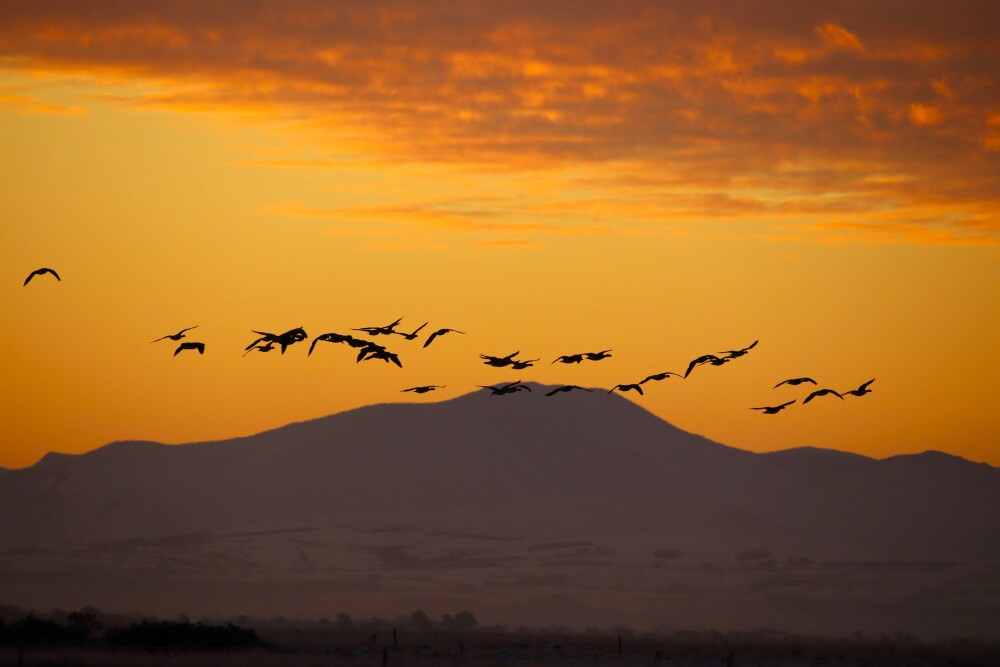
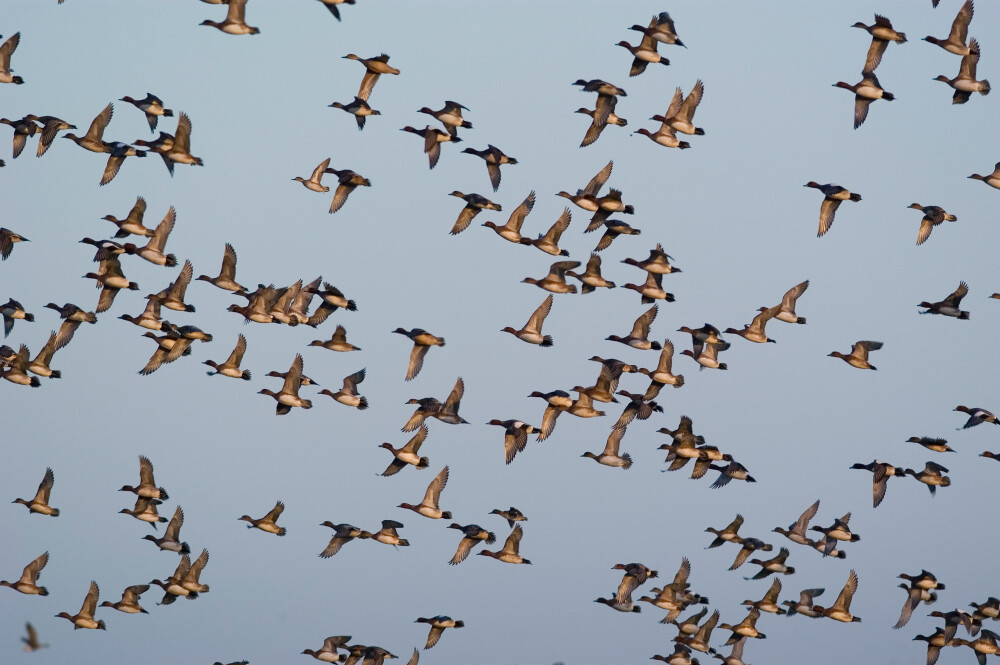
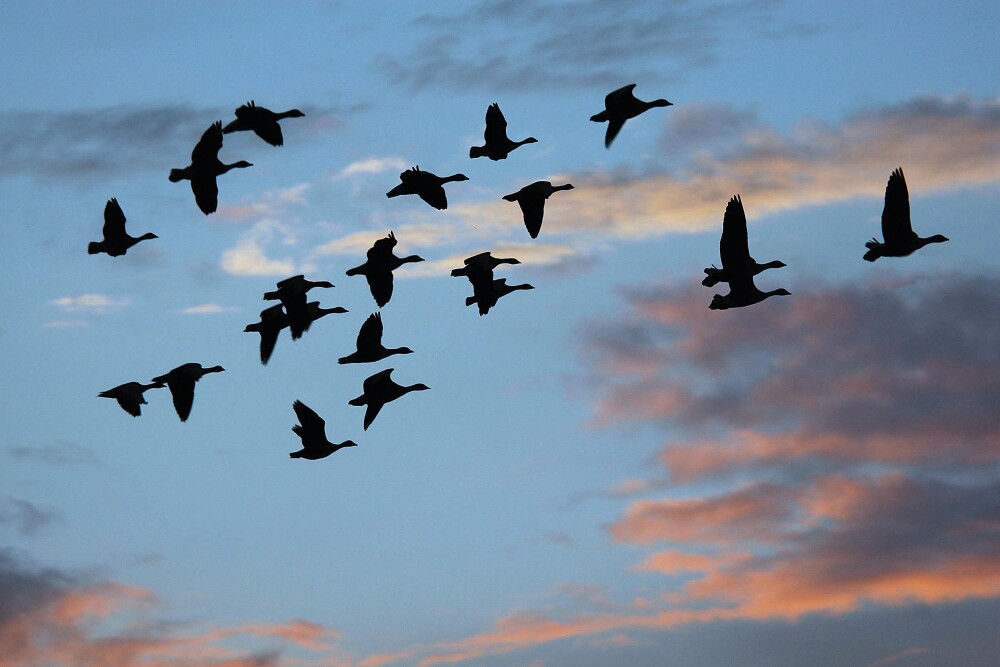
We have already seen the flights of a few goose species going over – but how do we know which one is which when they are so high above us? It’s not all that common to see them in perfect profile standing in front of you. The best way that we’ve found to identify those goose-shaped silhouettes is simple: their sound.
To honour the impending arrival of our Norwegian barnacle geese, we’ve created this helpful identification guide for several of our visiting geese species and included useful links to the xeno-canto website for sound identification.
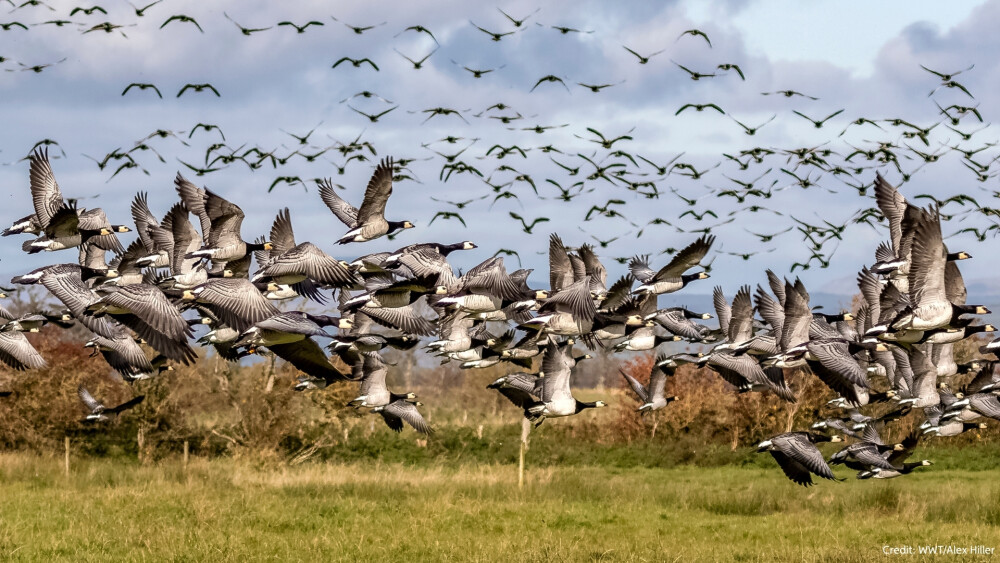
Barnacle Geese (Branta leucopsis)
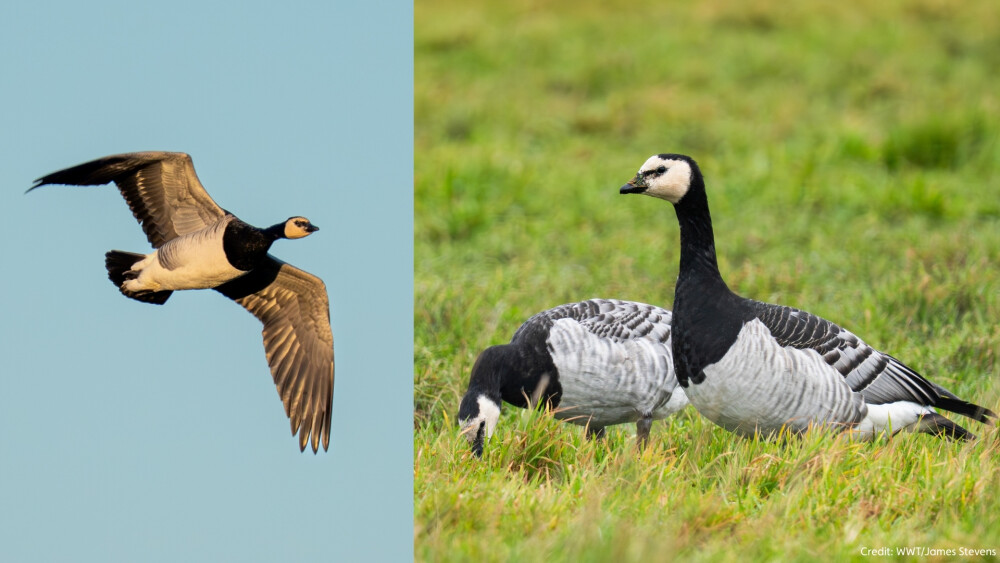
- Key features: Black neck and grey/white underbelly, cream face and short black beak
- Size: Medium (55-70cm)
- Sound: yap yap yap (hear on xeno-canto)
Over the years our reserve offered safe feeding for the Solway barnacle goose population helping it to increase hugely. As the population has increased to 40,000 a smaller proportion of the whole population graze in our goose fields now. But on busy days you can see thousands on the reserve, the whole coastline is the winter home for over 40,000 barnacle geese.
Fun fact: there has been much debate about the origins of these birds over history – there were medieval myths that they were born from driftwood or even goose barnacles. The latter of these was so well believed, that the Catholic community in Ireland would continue eating this bird throughout their meat-fasting Lent period, as they considered this bird to be fish, and this only changed in the 18th century.
Pink-footed Geese (Anser brachyrhynchus)
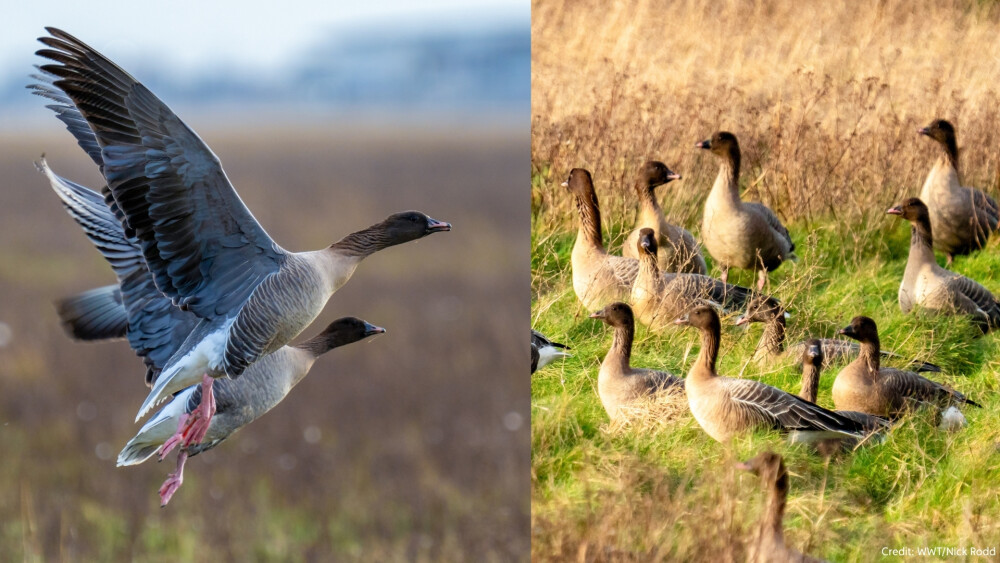
- Key features: Short black bill with a pink splodge in the middle, beige/brown body with darker bluish-grey tones towards the tail, iconic pink feet
- Size: Medium (60-75cm)
- Sound: wink wink wink (hear on xeno-canto)
A common visiting goose for us, these pink-footed geese breed in the colder north and winter in Europe. They are most easily identified by their high-pitched honks, and they prefer to build their nests on either the ground or the scarier locations of cliff edges in the Arctic tundra.
Fun fact: The most significant breeding site is at Þjórsárver in Iceland, which was only discovered in 1951 by the WWT founder Sir Peter Scott.
Canada Geese (Branda canadensis)
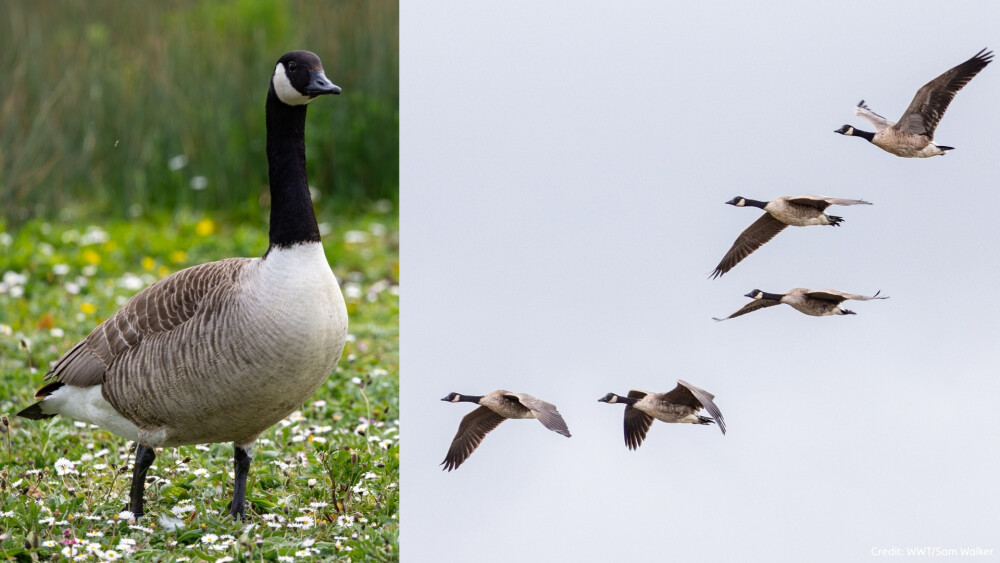
- Key features: Black head, bill, and neck, white ‘chinstrap’, brown body
- Size: Large, 90-110cm
- Sound: honk honk honk (hear on xeno-canto)
One of the most common geese to be seen in both the wilderness, suburban areas, and golf courses, is the Canada Goose. They are known for their territorial aggression, and they are also one of the most-feathered in the goose world, with a range of 20,000 to 25,000 feathers each.
(Not so) fun fact: these geese have become so common in North America, that they are often regarded as a ‘pest’ over there!
Greylag Geese (Anser anser)
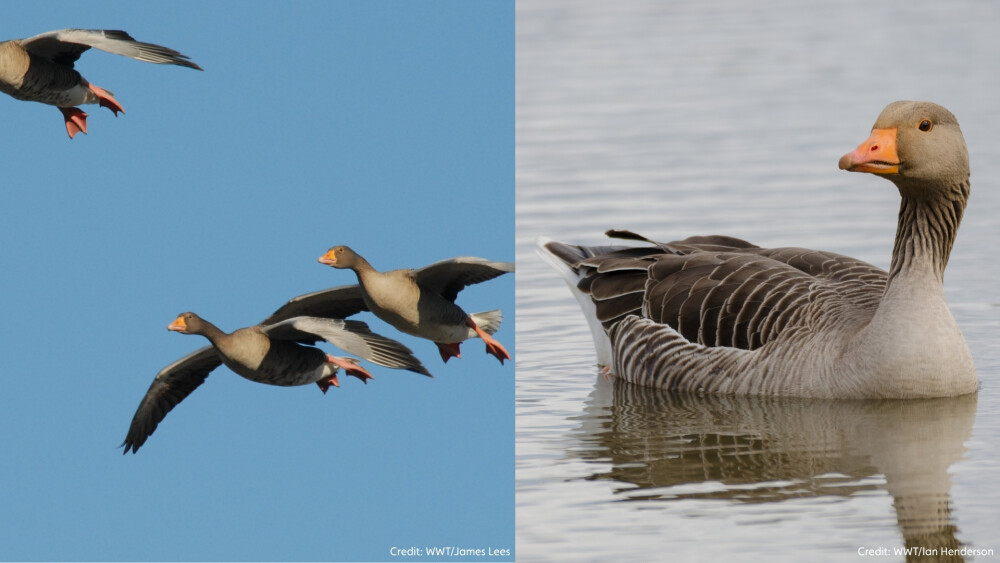
- Key features: Mottled greyish brown plumage, orange beak, pink legs
- Size: Large, 74-91cm
- Sound: quank quank quank (hear on xeno-canto)
Another fairly common sighting here, the greylag goose has the classic shaping of a large, stout goose. It is the ancestor to most breeds of domesticated geese, with known domestication taking place as early as 1360 BCE.
Fun fact: while all geese have monogamous relationships, the greylag goose is one of four goose breeds that is known to exhibit homosexual partnerships, at a rate of around 20% of all examined pairings.
If we’re lucky, the following geese may also visit us or have been sighted here before.
Brent (or brant) Geese (Branta bernicla)
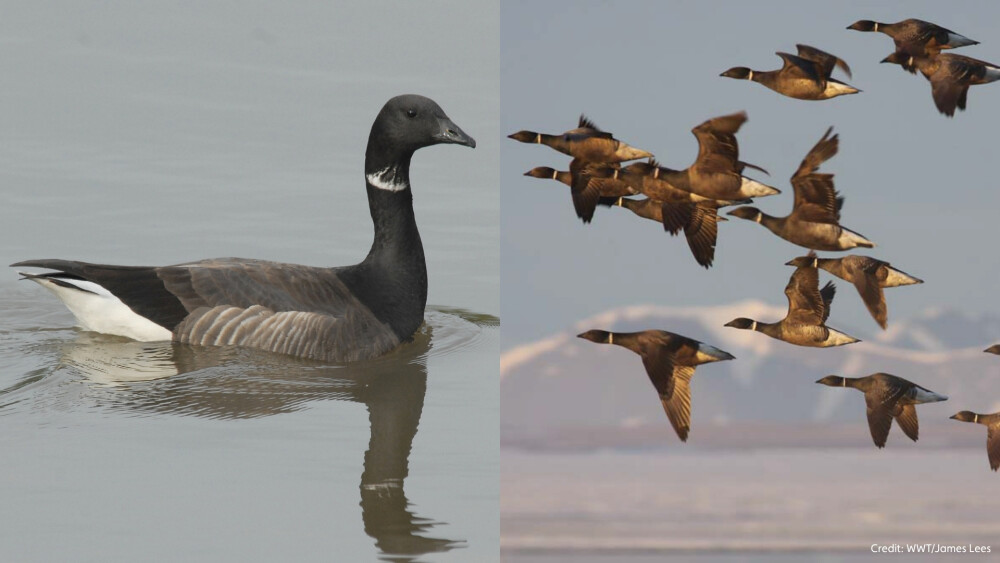
- Key features: Short, stubby bill, dark grey and brown body (sometimes lighter underneath, the pale-bellied variety), black head and neck, small white patches on sides of neck
- Size: Small, 55-66cm
- Sound: brank brank eek (hear on xeno-canto)
The smallest of geese to visit us, the Brent goose is about the size of a mallard. This breed loves a saltmarsh and feeds on the saltmarsh delicacies like eelgrass and sea lettuce.
Fun fact: this breed is known as the most coastal of geese breeds, appearing on coastlines up and down the UK every winter.
Cackling Geese (Branta hutchinsii)
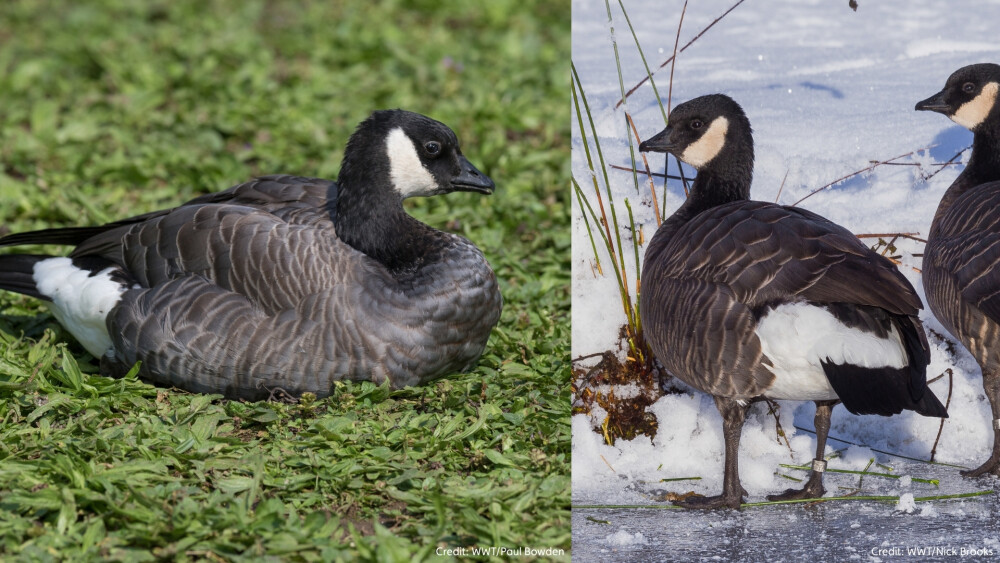
- Key features: Very similar to the Canada Goose, but smaller, with darker plumage.
- Size: Medium, 63-65cm
- Sound: hink hink hink (hear on xeno-canto)
This breed was considered to be part of Canada Goose breed until 2004, when it was reclassified and given its own name. They are called ‘cackling’ because their distinctive honk is higher pitched than the Canadas.
Fun fact: The smallest subspecies of this breed (Branta hutchinsii minima) has a bill of only 32mm.
Red-breasted Geese (Branta ruficollis)
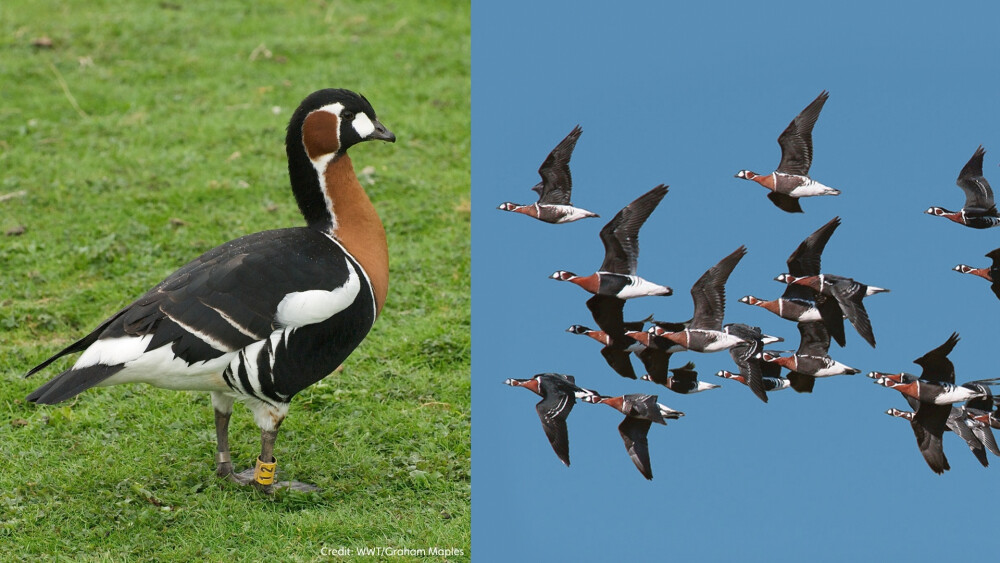
- Key features: Bold red breast, white and black body and wings with white markings along the neck and either side of the very short bill.
- Size: Small, 53-56cm
- Sound: honk-yink honk-yink honk-yink (hear on xeno-canto)
This goose breeds in Siberia and most commonly winters in the shores of the Black Sea. On very rare occasions, they can flock with brent or barnacle geese. If you are lucky enough to spot one of these on the reserve, they are most likely feral, having escaped domestic captivity.
Fun fact: This goose is known to nest near the nests of birds of prey in Siberia, as the raptors can act as protectors and deterrents of their main predator, the Arctic Fox.
Snow Geese (Anser caerulescens)
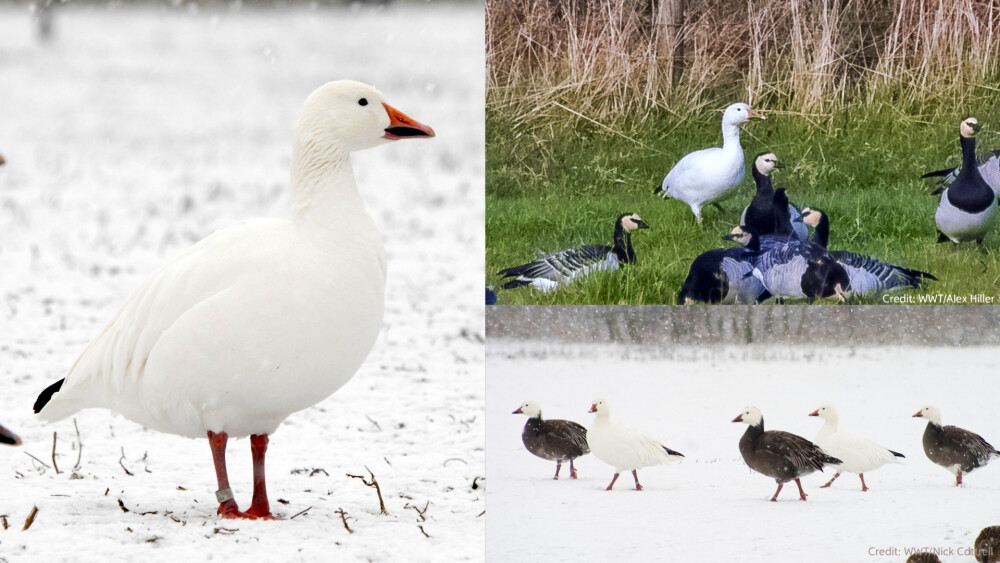
- Key features: Two colour forms, one all white with black wing tips, one white-headed with blue/grey body
- Size: Medium, 65-80cm
- Sound: wap wap wap (hear on xeno-canto)
This species does not breed in the UK (unless they have escaped from captivity) and are often found in the midst of other geese flocks. They breed in the Arctic, Greenland, and Siberia, and are most commonly found wintering on the Atlantic coast of the USA.
Fun fact: The oldest snow goose in recorded history lived up to almost 31 years old.
We encourage you to come down this autumn and winter to see if you can spot all these geese on our reserve – you may be lucky enough to get a full house!
By Georgia Pope, Engagement Officer