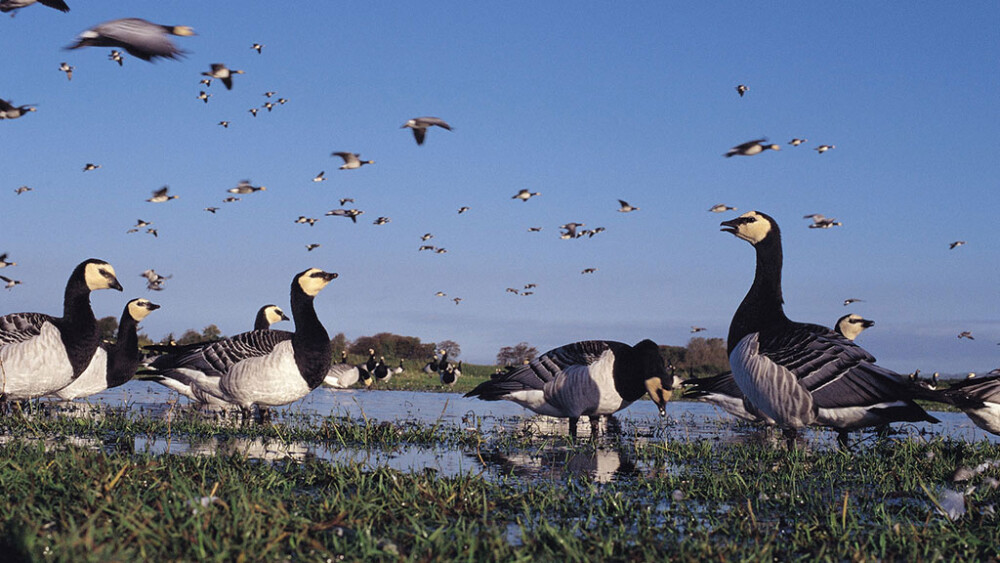
Header image: Barnacle geese feeding on wetlands
1. Barnacle Invasion
You hear them first. The honking of thousands of unseen barnacle geese merging in one high-pitched, rushing roar that wells up from the morning mist. Then you see them. Straggly horizontal lines that stretch, waver and overlap until each individual skein is subsumed into one vast swirling mass.
The noise crescendos as the expanding flock circles above the feeding grounds and starts descending, birds raining down on the pasture below. Soon the foreground is a restless hive of motion as thousands of hungry geese crop the sward, each individual inching forward, head down, like avian wildebeest nibbling their way across a Scottish Serengeti.
Peeking from behind the hedge, so as not to spook them, your binoculars alight on the closest individuals, revealing black and white markings as delicate as any wood engraving. A distant piping of oystercatchers from the mudflats behind tells you that the roost site is now empty.
In the late 1940s, no more than 300 barnacle geese overwintered in the Solway Firth. Today, thanks to WWT and our conservation partners, more than 40,000 arrive every year, turning WWT Caerlaverock Wetland Centre into one of Europe’s most impressive wildlife spectacles. Long ago, our ancestors – who were unable to find barnacle goose nests – believed that these birds hatched from goose barnacles. Today we know that they breed on Arctic Svalbard, then, when winter snows blanket the tundra, migrate 2,000 miles south to our more temperate shores, where there is food all winter. Sometimes the truth can be as miraculous as fiction.
Where: Caerlaverock
When: October to April
Time: The geese can be seen feeding on the reserve all day
2. Busy Bewick’s
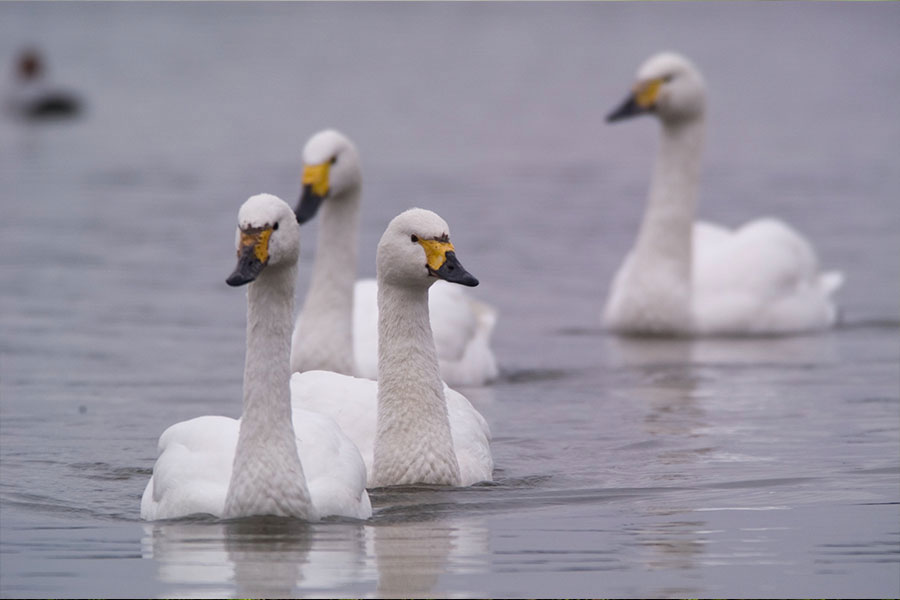 Bewick's swans on the water at Slimbridge
Is there trouble on swan lake? Necks arched and wings beating, two Bewick’s rear up from the water in an apparent altercation, their high bugling calls cutting through the air. But this is not a bust-up. The birds are a pair, and their display signals the renewal of courtship. It's a process that will soon see them depart to begin their annual 2,000-mile spring odyssey back to their breeding grounds in Russia.
The WWT Slimbridge Wetland Centre staff know these two birds well. Like all the swans here, and at WWT Welney, their unique bill markings confirm their individual identities. The markings have continued to inform one of the longest ongoing research programmes of any bird species in the world. Bewick’s swans pair for life and some couples have returned for more than 20 years.
Where: Slimbridge and Welney
When: October to March
Time: Daily feeds
3. Winter Water Rail
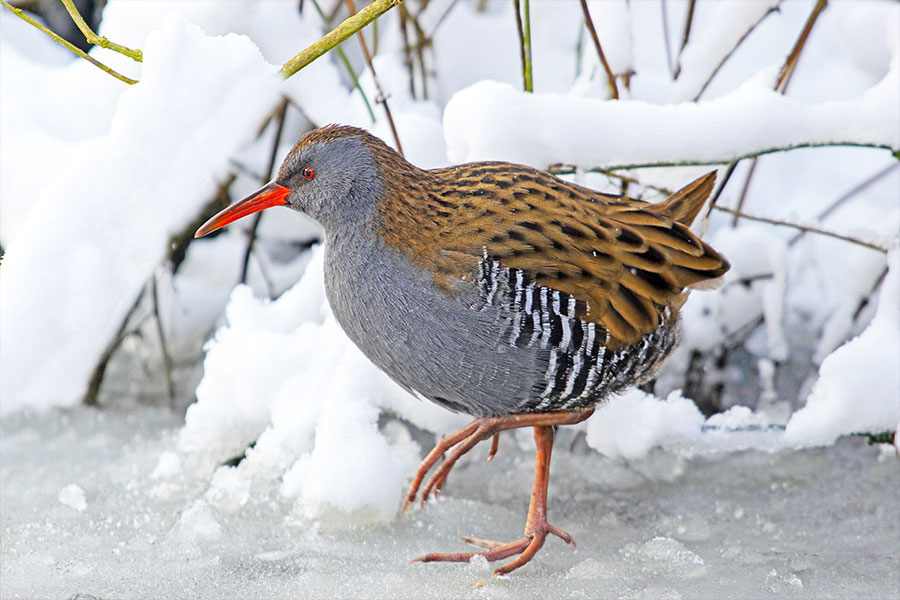 A water rail walking on ice
On a crisp winter morning at WWT Arundel Wetland Centre, a movement in the reeds disturbs a foraging wren. The diminutive bird cocks its tail and gives its scolding alarm trill. On cue, a larger bird emerges from below. It resembles a skinny, upright moorhen, but the low winter light reveals striking blue-grey underparts, a chestnut back and red dagger bill. A water rail!
Though rarely seen, this secretive reedbed denizen occurs on many WWT reserves, its presence most often betrayed by its pig-like squealing calls. During winter cold snaps, when visitors from Eastern Europe swell the native population, it shows a more public face, emerging from the reedbeds in search of open pools. Watch quietly or it will dash away, white undertail flicking in panic, to resume its skulking.
Where: Arundel; also Steart, London, Slimbridge and Caerlaverock
When: November to February at Caerlaverock, October to March at Arundel
Time: All day, easier to see in cold weather
4. Owl Arrivals
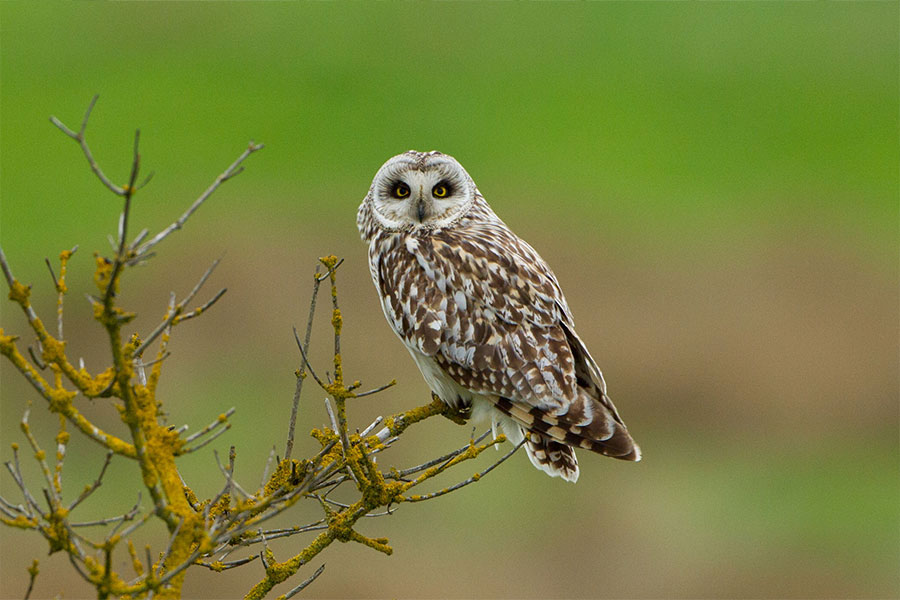 A short-eared owl at Wicken Fen, Cambridgeshire
The light is fading when a short-eared owl materialises from the gloom at the back of the marsh. It quarters the ground methodically, occasionally dropping from sight in pursuit of a vole. Drifting closer, it alights on a fence post. Your binoculars pick out blazing yellow eyes framed in dark spectacles, a glare of pure predatory intent. As you watch, the owl ducks to evade two passing carrion crows, which divert from their flight path to dive-bomb the intruder. Then it launches again to resume the endless quest for food.
The short-eared owls that visit WWT Llanelli Wetland Centre every winter come mostly from further north and continental Europe. They are drawn by the rich rodent life in the marshes and are not the only owls to find a home on the reserve.
Barn owls quarter the rough ground in a similar fashion, moth-like in their ghostly white plumage. Little owls pop up around old buildings, bullheaded and inquisitive. And the quavering hoots of tawny owls echo after darkness through the woods, where the dark branches may even hide a roosting long-eared owl, the rarest of this nocturnal quintet.
Where: Llanelli; also Caerlaverock, plus Welney for barn owls and Steart for short-eared and barn owls, and Washington for tawny owls
When: Winter
Time: Look for short-eared owls hunting during the day
5. Whoopers Touch Down
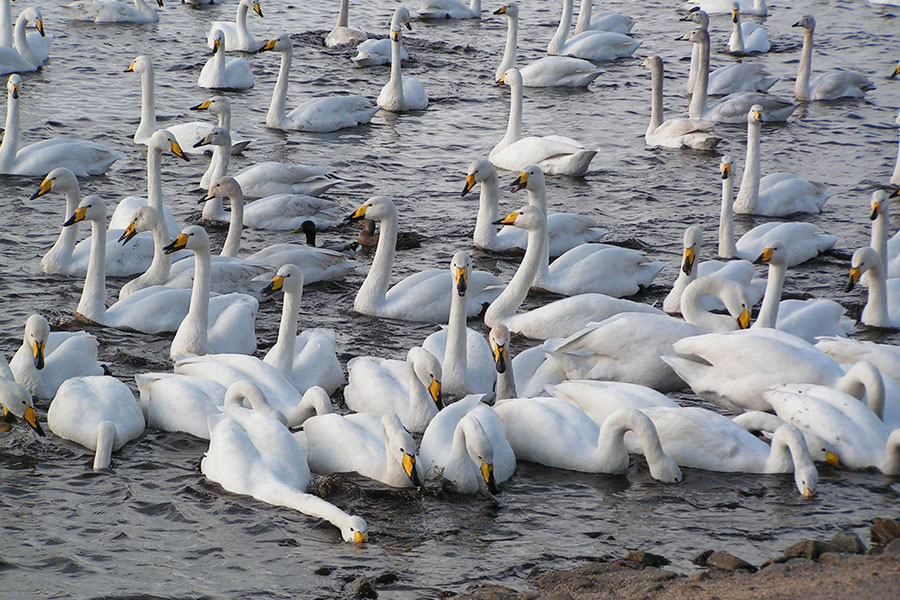 Up to 2,000 migratory Icelandic whooper swans winter at Martin Mere
White wings beat down from the grey winter sky, fanning higher as the birds apply their aerial brakes. Long necks outstretched and black feet extended, the whoopers splash down, clearing a landing strip among the smaller wildfowl as they hydroplane to a halt across the surface. On the water, they break into an excited trumpeting, then, shuffling wings and tail back into position, recover their composure and glide more serenely towards their companions.
Hundreds of whooper swans, their snow-white ranks punctuated with the grey-browns of this year’s youngsters, already crowd the lake as they gather for the afternoon feed. Many have been at WWT Martin Mere and Welney Wetland Centres since October, refugees from the frozen north. They touched down after a 500-mile journey south from Iceland, the longest sea crossing of any swan species worldwide. Their numbers have reached 2,000 at Martin Mere and 7,000 at Welney.
Where: Martin Mere, Welney and Caerlaverock
When: October to March
Time: Daily feeds
6. Capital Bittern
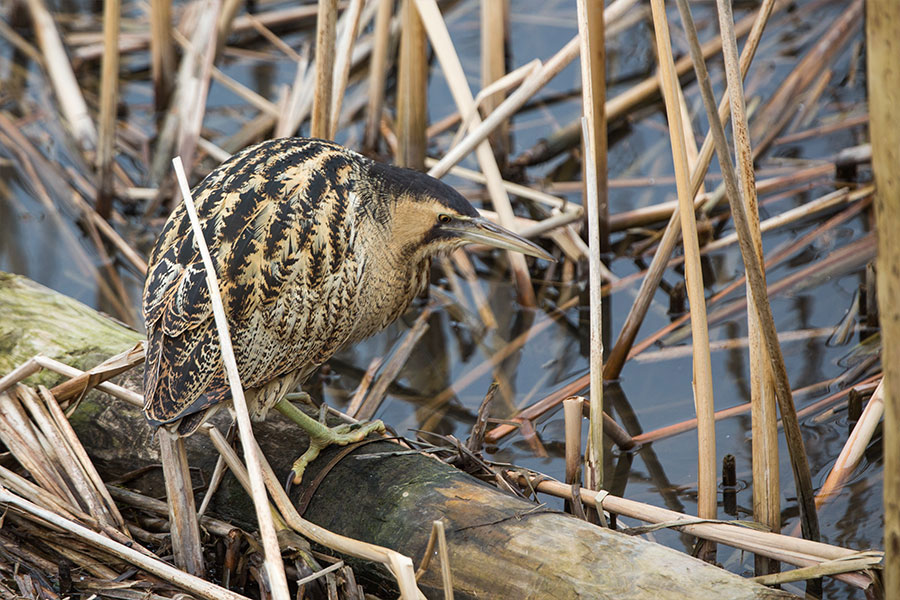 Bitterns move silently through reeds at the water’s edge, looking for fish
A bittern in the centre of London? Surely that’s just a birdwatcher’s fantasy. And yet there can be no mistaking that streaky-brown form lurking in the reedbed at the back of the lake. As coots fuss past in the foreground, this secretive bird emerges into plain view.
Its long legs are those of a heron, yet there’s something almost owl-like about its cryptic camouflage plumage. At the shrieking swoop of a black-headed gull it freezes, briefly pointing its dagger bill skyward, then slips back behind the screen of phragmites reeds and is instantly lost to view.
Up to six of these enigmatic visitors have been recorded at WWT London Wetland Centre in winter – their numbers highest during a cold snap, when individuals arrive from the big freeze in continental Europe to make the most of our milder conditions. Be patient, keep your eyes peeled and you may just get lucky.
Where: London. Also Llanelli, Arundel and Slimbridge
When: Most visible in winter
Time: Dawn and dusk
7. Whistling Wigeon
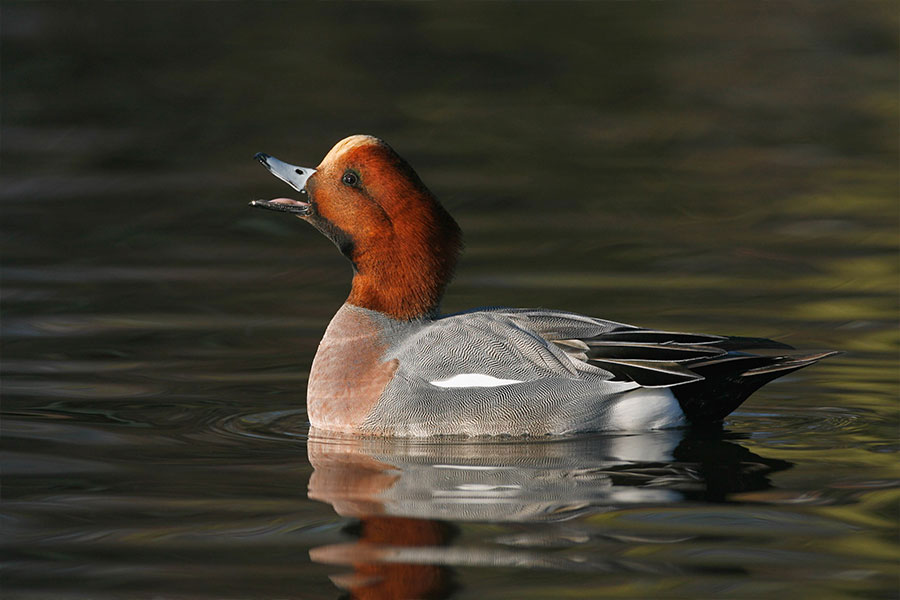 In winter, many wigeon visit the UK from Iceland, Scandinavia and Russia
It’s a frosty morning at WWT Welney Wetland Centre and a chorus of excited whistles announces that wigeon are taking flight nearby. It's just a fraction of a population of more than 10,000 that has taken up winter residence on the grazing marshes. They circle the hide and splash to a halt in front of you, the males decked out in their handsome livery of pink breast, chestnut head and creamy crown, the females a camouflage brown.
Numbers of this gregarious duck have been building up on the reserve since late autumn, gradually overtaking those of their dabbling companions, the mallard, teal and shovelers.
Other WWT reserves host similar wigeon gatherings, the birds waddling over flooded grasslands and upending in the shallows, nibbling all the while. When 3,000 take to the air at once, the whistling is impressive.
Where: Caerlaverock, London, Martin Mere, Slimbridge and Welney, plus Castle Espie, Llanelli, Steart and Washington
When: Winter
Time: All day
8. Boxing Hares
A couple of brown hares sparring at Welney
Lapwings scatter as the two assailants rear up on their hind legs, trading fast, frantic blows. They dance back and forth, dropping to their haunches then standing again, before one dashes away at lightning speed, disappearing over a rise. It may only be late February, but ‘mad March hares’ are already gearing up for the breeding season. The sparring is not between rival males, as is often thought, but between unreceptive females and over-amorous suitors.
Today, brown hares are in decline across the UK, but WWT Welney Wetland Centre offers a perfect opportunity for close encounters with our speediest mammal. And winter, when the short grass leaves the hares more conspicuous is the best time to look, especially at Lady Fen, when 100 or more gather to nibble at what remains of the pasture.
Try a guided walk, and look out for those long, giveaway ears and wild golden eyes.
Where: Welney. Also Caerlaverock all year and Washington
When: December to February
Time: Free hare walks
9. Lapwings and Golden Plovers
A mixed flock of golden plover and lapwing in flight over Slimbridge
Peregrine alert on Slimbridge marsh! An eruption of wings shatters the quiet December afternoon as thousands of golden plovers and lapwings take flight en masse.The hunting falcon materialising from nowhere and sweeps through their ranks. In the air the birds divide, the two flocks twist and wheel to evade the predator. Frustrated, the peregrine gives up and heads for the horizon. As the birds settle down the air fills with their calls, the golden plovers’ plaintive piping and the lapwings’ shrill ‘peewits’.
Up to 6,000 of the former and 7,000 of the latter spend the winter here, commuting in to Slimbridge each morning from fields inland. The golden plovers hail from the Russian Arctic and the lapwings from Eastern Europe.
Where: Slimbridge and Steart. Washington (lapwings only)
When: November to February
Time: Peak numbers at midday, also during high tides
10. Pinkfeet On Parade
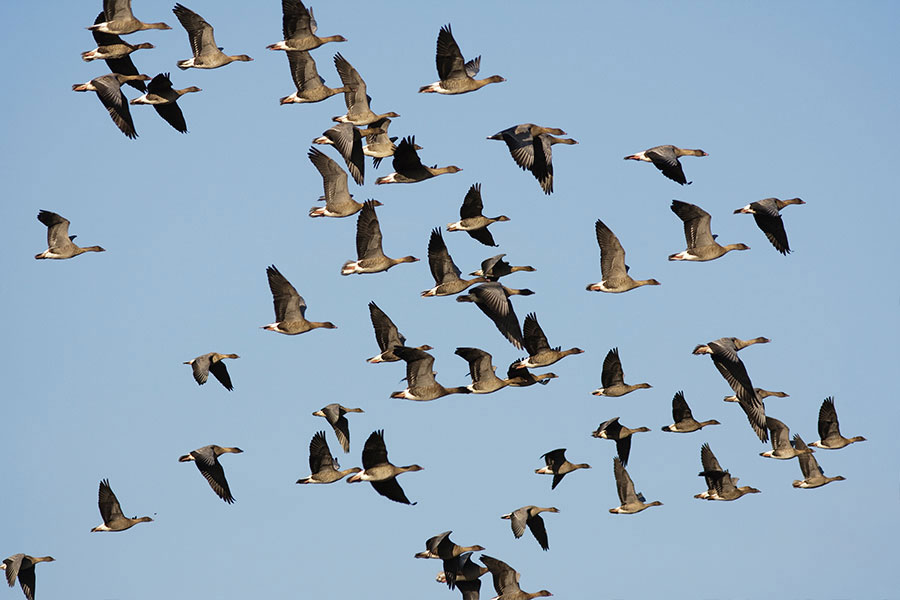 It’s a perfect winter sunset and the birds arrive silhouetted against a vivid backdrop of pinks and golds as they commute back from the fields to their roost at WWT Martin Mere Wetland Centre. The numbers are impressive with some 5,000 of the birds remaining throughout the winter, but this doesn’t compare to the tens of thousands that overwhelm the reserve during October.
For these travellers, the food-rich wetlands offer a vital pit stop. It's a chance to rest and refuel after their 500-mile flight from Iceland before continuing to wintering grounds further south. Numbers at this time may top 40,000, which is a significant chunk of the world population. Now, as the early darkness of January falls on the reserve, you watch those that remain hunkering down on the water among their fellow Icelandic voyagers, the whooper swans.
Where: Martin Mere and Caerlaverock
When: September to April
Time: Dawn and dusk