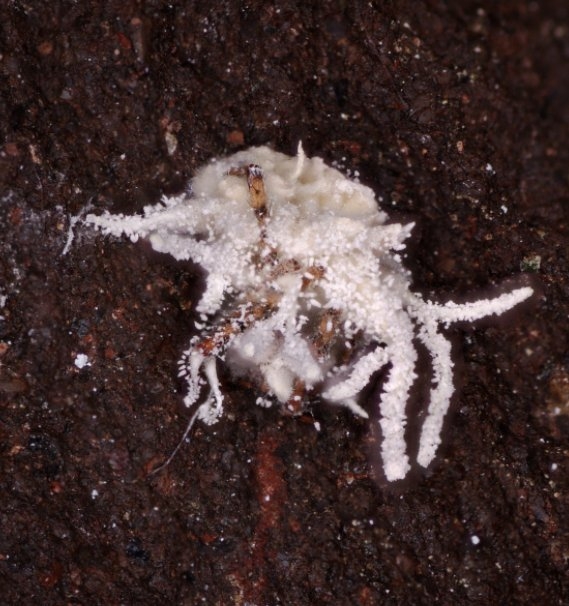
A fungus discovered in an old Victorian gunpowder store at WWT Castle Espie has been revealed as a completely new species, now formally named Gibellula attenboroughii.
The parasitic fungus was first found growing on a cave spider by WWT volunteer Jonathan Clark during filming for the BBC Winterwatch series at Castle Espie in 2021. Subsequent DNA testing by Dr Harry Evans from CABI (Centre for Agriculture and Bioscience International) confirmed that the fungus was new to science.
Originally referred to colloquially as Gibellula bangbangus -named by BBC Springwatch viewers in honour of its discovery site, the species has since been formally described by mycologists and given the scientific name Gibellula attenboroughii in recognition of naturalist Sir David Attenborough.
About the fungus
Gibellula attenboroughii is a parasitic (parasitoid) fungus that infects spiders, particularly the orb-weaving cave spiders Metellina merianae and Meta menardi. When infected, the spider’s behaviour changes dramatically: instead of staying within dark, sheltered habitats like caves or storerooms, the spiders move to more exposed surfaces such as ceilings and walls before they die. This behavioural manipulation likely benefits the fungus by increasing spore dispersal.
Scientists have noted parallels between this “zombie-like” behaviour and that caused by other parasitic fungi, such as those affecting ants.
In addition to behavioural effects, earlier reports suggested the fungus might produce bioactive compounds with potential medical research applications.
Distribution and research
G. attenboroughii has only been recorded on the island of Ireland so far, with specimens found in multiple cave systems in both Northern Ireland and the Republic of Ireland. There are also tentative records of similar fungi in Wales that may represent this species.
Castle Espie and ongoing significance
Manager of Castle Espie, Paul Stewart, remarked on the significance of the find: “It’s a mystery how this new species came to evolve in the microclimate of the gunpowder store at Castle Espie… but it’s a world first here in Northern Ireland and may yield benefits through further study.”