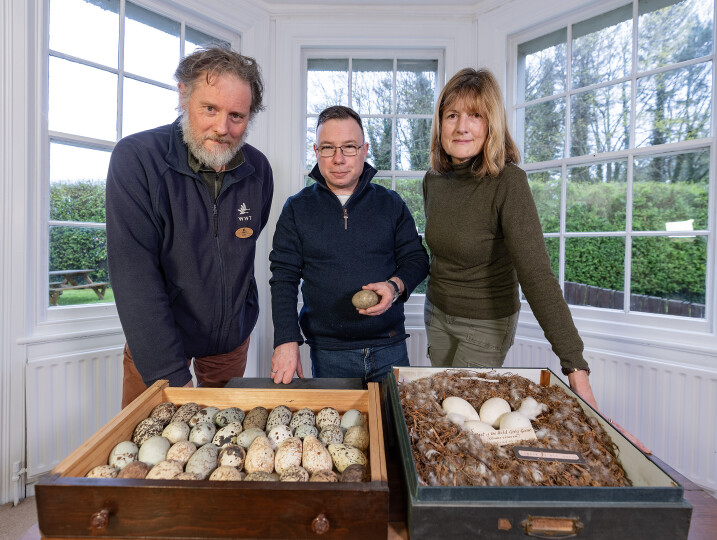
The Natural History Museum, London, is about to embark on one of the largest and most complex movements of a late 19th century / early 20th century ornithology collection in decades. For over 50 years, one of the United Kingdom’s most important natural history collections has been cared for at WWT Castle Espie, on the banks of Strangford Lough, three miles south of Comber, County Down, Northern Ireland.
Encouraged by the pioneering conservationist Sir Peter Scott, Patrick ‘Paddy’ Mackie’s inspired purchase of Castle Espie in 1977, and the creation of the Castle Espie Conservation Centre, which opened its doors in 1982, inadvertently also saved the globally important natural history collection held on the site. The collection remained with the Mackie family after the transfer of the site to WWT, the wetland charity, to form WWT Castle Espie.
After an initial assessment by staff at the Ulster Museum, Douglas G. D. Russell, a Senior Curator at the Natural History Museum, London, who specialises in egg and nest collections, was invited to study the collection in 2024.
Douglas G. D. Russell said, “This is an exceptionally important collection, not just for its scale, but for its extraordinary scientific potential. Robert Henry Read’s meticulous notes, alongside the specimens, provide a rare, data-rich record of historical bird populations and environments.”
“By bringing the collection to the Natural History Museum, we can unlock new research opportunities, using technologies such as AI-driven transcription to rapidly make these records accessible - offering powerful insights into biodiversity change and the impacts of climate change over time, and helping us better understand and prepare for future environmental change.”
WWT Castle Espie holds material from several prominent naturalists, but the majority was collected by Victorian naturalist Robert Henry Read (1857-1929). A civil engineer by profession, Read started seriously studying birds and collecting samples of eggs and nests in the early 1880s and continued for nearly 50 years until his death in 1929. His beautiful, handwritten notebooks give detailed notes on all the specimens he collected and acquired from other naturalists. They detail his ornithological trips to Scotland inc. Outer Hebrides, St. Kilda and Aisla Craig. He also undertook significant continental collecting trips inc. Sweden, Norway, Denmark, Corsica where he collected information on the rare Corsican Nuthatch Sitta whiteheadi.
Paul Stewart, Centre Manager at WWT Castle Espie said: "WWT Castle Espie Wetland Centre, opened to the public by Paddy Mackie in 1982, sits on the shores of Strangford Lough, the largest sea lough in the UK or Ireland. Upon opening, it was one of Northern Ireland's first facilities of its kind, serving as a hub for conservation, leisure, learning and environmental engagement.
“Now proudly managed by WWT, the wetland charity, it is our only site in Northern Ireland and one of 10 across the UK. Founded by Sir Peter Scott, a firm friend of the Mackie family, WWT is the leading wetland conservation charity in the UK, championing wetland creation and restoration to tackle the world's most pressing environmental issues.
“Paddy Mackie’s historic egg collection, held at WWT Castle Espie, provides vital data for conservation research, and ensures his legacy inspires us to continue unlocking the superpowers of wetlands. Because when wetlands flourish, all life will flourish."
In total, the collection is held in 36 cabinets and boxes, all of which will be carefully packed in April 2026 by two specialist curators and transferred to the Natural History Museum Bird Collections held at Tring in Hertfordshire. Egg collecting is now illegal in the United Kingdom, and the Republic of Ireland; and scientific collecting is now only undertaken under strict ethical guidelines and licence, but these historical collections remain a unique source of ornithological data; both from the egg and nest samples and their associated documents. The NHM is embarking on a major project this autumn innovatively using AI to automate and speed up the transcription and processing of handwritten documents -opening this and other collections for immediate research on climate change and biodiversity loss.