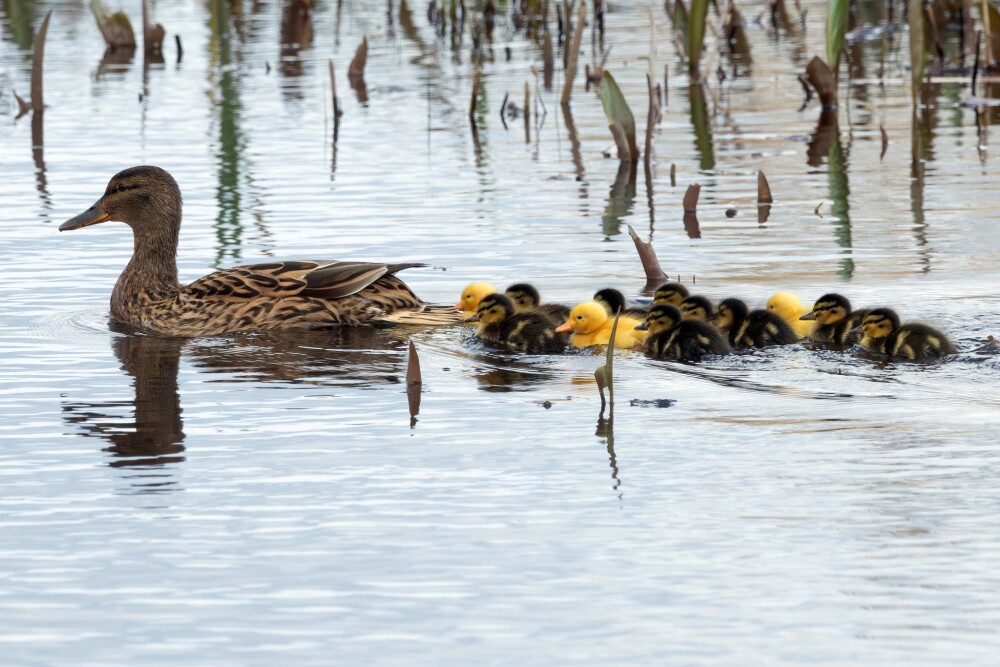
Spring has burst into song across the wetlands! Late March has brought shimmering flocks and heart‑lifting moments: seven Little Grebe and a ghosting Hen Harrier over Deep Water Lake, a Whimbrel pausing on Saline Lagoon, and a smoky, whirling flock of Knot on Freshwater Lagoon. On Dafen Scrapes, almost a thousand Black-tailed Godwit rose like a moving cloud, while a chorus of Redshank stitched the shoreline with scarlet legs. Overhead, Swallows skimmed the water and a newly arrived Willow Warbler sweetened the breeze with its tune. And everywhere you look, tiny Mallard ducklings, including a brood with three bright yellow bundles of sunshine by the Peter Scott Hide, are proof that spring is truly here.
Wildlife sightings from 24th March to 28th March 2026
Highlights: Hen Harrier, Swallow, 1000 Black-tailed Godwit, Willow Warbler
Over on Deep Water Lake, seven Little Grebe bobbed their fluffly bustles between the reeds like tiny clockwork divers, their trilling calls carrying on the breeze. On 23 March, a ghostly Hen Harrier swept low over the water with effortless grace; one of those sightings that makes you pause, breathe, and just watch. Later in the week, Reserve Warden Peter was delighted to see Swallows swooping low over Deep Water Lake, snipping insects from the air with that unmistakable, scissoring flight. And on Friday 27 March, he heard the soft, sweet cadence of a Willow Warbler filtered from the willow scrub. Spring migration is gathering pace!
The lagoons have been alive with big wader energy. On Freshwater Lagoon (23 March), a tight, smoky-grey flock of around 70 Knot shimmered across the water’s edge, the whole group turning as one like an airborne shoal of fish. Just two days later (25 March), we counted 198 Redshank there, a wonderful commotion of crimson legs and needle-fine bills, piping calls knitting through the wind as birds probed and pattered along the shallows. A lone Whimbrel on the Saline Lagoon (23 March) brought that distinctive, rippling whistle, downturned curve of a beak and bold striped head, a striking passage visitor with a story of long journeys worn into every wingbeat.
And then, rather conversely to the solo Whimbrel, a showstopper of a gathering. On Dafen Scrapes (25 March), the mud seemed to move with birds. Volunteer Stephen Chambers counted c.1,000 Black-tailed Godwit (corroborated by another counter at the same time), a truly epic flock. When a flock that size rises together, it’s like watching the sky itself rearrange: pale underwings flashing, cinnamon hues beginning to glow on a few birds as breeding plumage develops, and that chorus of chatter and alert notes filling the air. It’s the kind of spectacle that stays with you long after the last ripple flattens.
Closer to the hides, spring has taken a much fluffier form. Mallard ducklings are appearing across the wetlands, including the brood pictured in our featured photo. Photographer Neil Fermandel watched them by the Peter Scott Hide, where something unusual caught his eye - three bright yellow ducklings among their more typical, and equally as cute, brown-toned siblings. Tiny, buoyant and busy, they trailed after mum through dappled water, each ripple a little ring of sunshine.
Whether you come for the quiet thrill of a passing Hen Harrier, the gentle music of Willow Warbler, or the awe of a thousand Black-tailed Godwit lifting as one, this is a superb time to visit. Bring binoculars if you can (or hire a pair from the shop for £5), take your time in the hides, and let the season unfold in front of you. Every path, pool and reedbed has a story to tell.