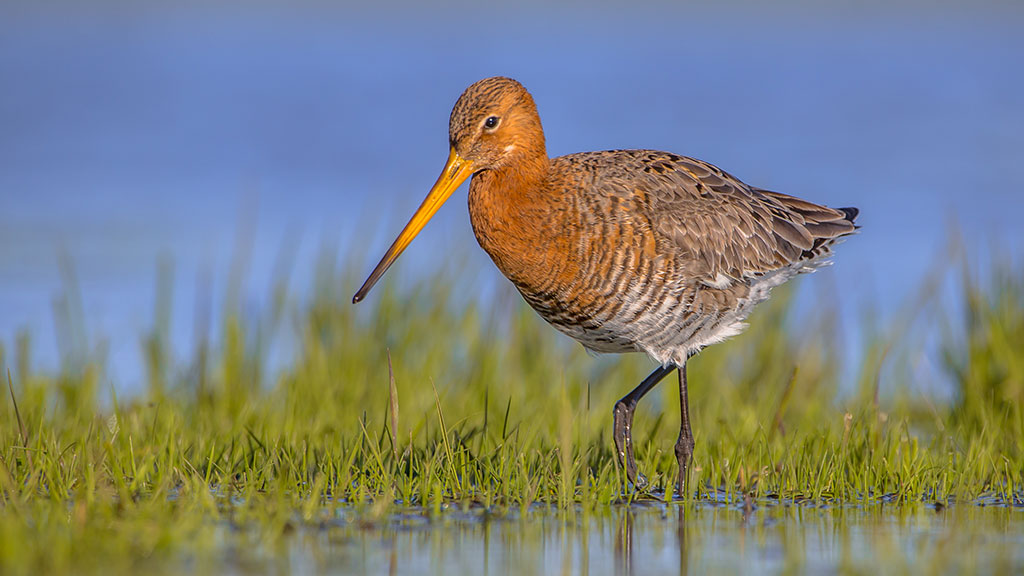
Adult black-tailed godwits are looking gorgeous in their summer plumage; their bright rusty orange chests shining in the spring sunshine and their wonderful ‘wickering’ mating calls can be heard from afar.
Black-tailed godwits are a large and elegant wading bird with a long beak, long legs, a clear white wing stripe and a black tail that can distinguish it from the similar-looking bar-tailed godwit. They use their distinctive long beak to probe in the mud, feeding on invertebrates such as worms, molluscs and crustaceans.
Each spring, despite spending the entire year apart, black-tailed godwits reunite with their life-long partner at the very wetland site where they first met. A true wetland romance. The birds will then court, nest and hatch eggs. The female, her job now done, will leave and the responsibility of feeding the chicks until they are ready to fend for themselves is the responsibility of the male. Next year, they will meet up once again, same time same place, to do it all over again.
The problem
Unfortunately, black-tailed godwits are a bird under serious threat. In the last 25 years alone, the population in Europe has halved. Some of the main reasons for this staggering decline include draining of wetland habitats that they depend on to create more farmland, climate change, flooding and predation. The remaining breeding birds in the UK are left in just a few fragmented spots leaving them even more vulnerable than ever.
WWT, with thanks to all our supporters, members and visitors, has been working hard to help these birds and tackle some of these challenges with local stakeholders. Project Godwit ran from 2017 and 2023 in partnership with the RSPB, with funding through EU Life. Together, we created new habitat in the Ouse Washes, installed predator fences and boosted chick numbers through a process called headstarting. This was a first of its kind technique where black-tailed godwit chicks were raised in captivity, and later released into the wild, helping to boost population numbers by 800%.
Our godwit conservation work continues through our Godwit Futures project which began in 2023. Godwit Futures follows on from the seven-year project in partnership with the RSPB and EU life, Project Godwit and will allow us to headstart more black-tailed godwits and continue to help support the UK’s breeding population of these endangered waders. The Godwit Futures project works with the National Black-tailed Godwit Working Group consisting of WWT, RSPB and Natural England and has received funding from Natural England’s Species Recovery Programme Capital Grant Scheme.
Here’s what has been going on with the project recently as the team prepare for, hopefully, an exciting breeding season.
New Aviary
In February this year, the team began work on creating brand new aviaries at WWT Slimbridge for the population of black-tailed godwits that have been reared in our conservation breeding programme. These structures are designed to house sexually mature adults and provide each potential breeding pair with the space and privacy they need to encourage natural breeding behaviours and improve their breeding success.
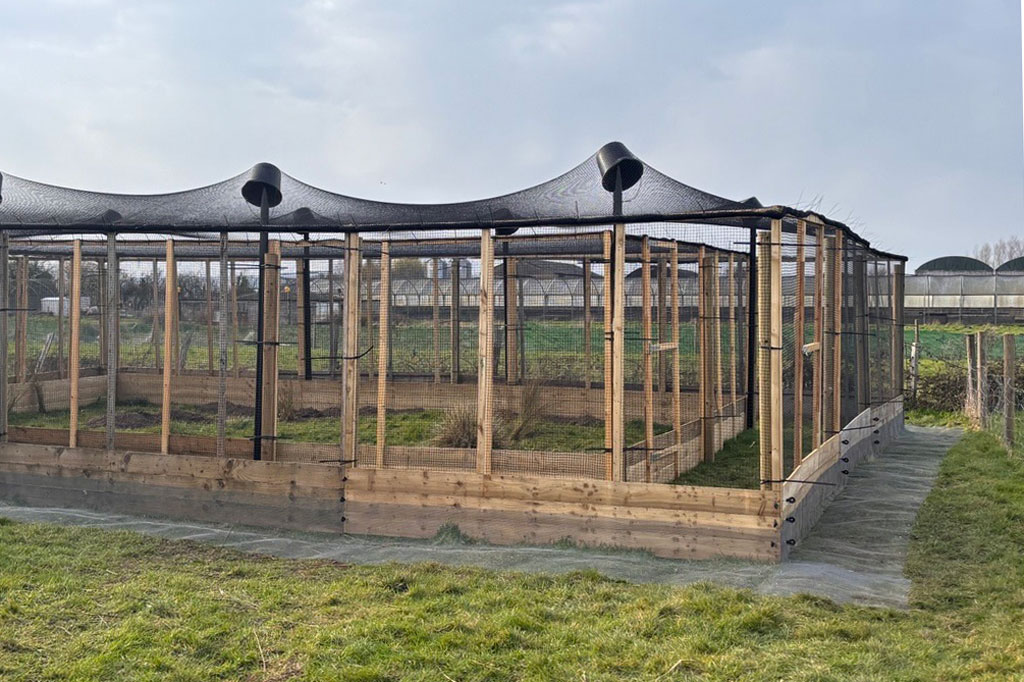 One of the new aviaries at WWT Slimbridge
The aviaries are located away from the main visitor centre, within our bio-secure Conservation Breeding Unit (CBU), to give the birds a safe place to breed. All the aviaries were landscaped and finished by the end of March, and by April, ready for the godwits to move in. Now, they’re currently home to seven pairs of birds.
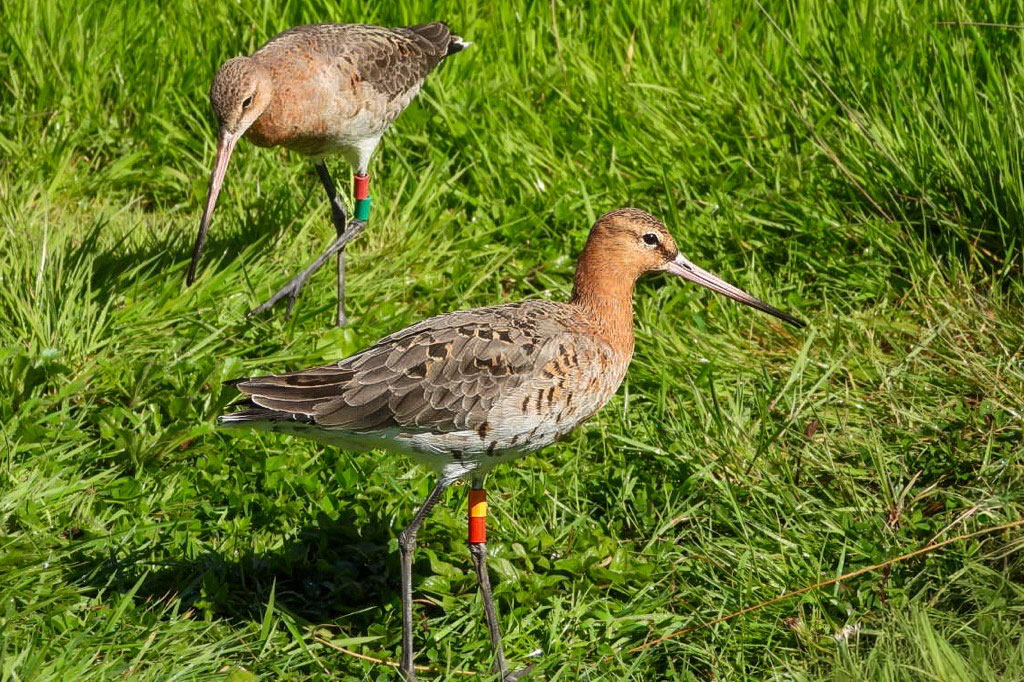 A pair of black-tailed godwits in their new breeding aviary.
Monitoring
Over at WWT Welney, wild birds that were released as part of the Godwit Futures project are beginning to return to the Ouse Washes. Our newly appointed Monitoring Officer, Catrin, is currently surveying the area with her optics to see which individuals have returned. At the time of writing, 20 individuals from the initial project are back on the wetlands and we are eagerly waiting to see if any of them will start nesting . Birds released as part of our headstarting project began breeding in 2018, and now, released birds make up 40% of the UK breeding population. Unfortunately, in 2025 no chicks fledged in the wild. We made a few changes to the way we manage this site, so we eagerly wait to see if the returning wild birds are more successful this year.
We want to thank everyone who has supported our godwit conservation projects over the years. Together, we are giving these incredible birds the best possible chance at thriving long into the future.