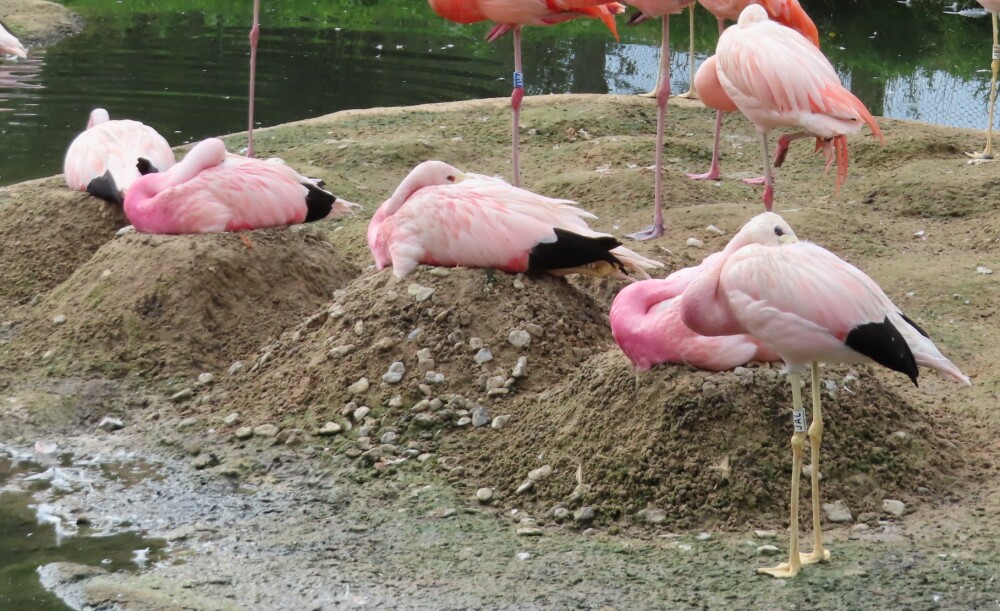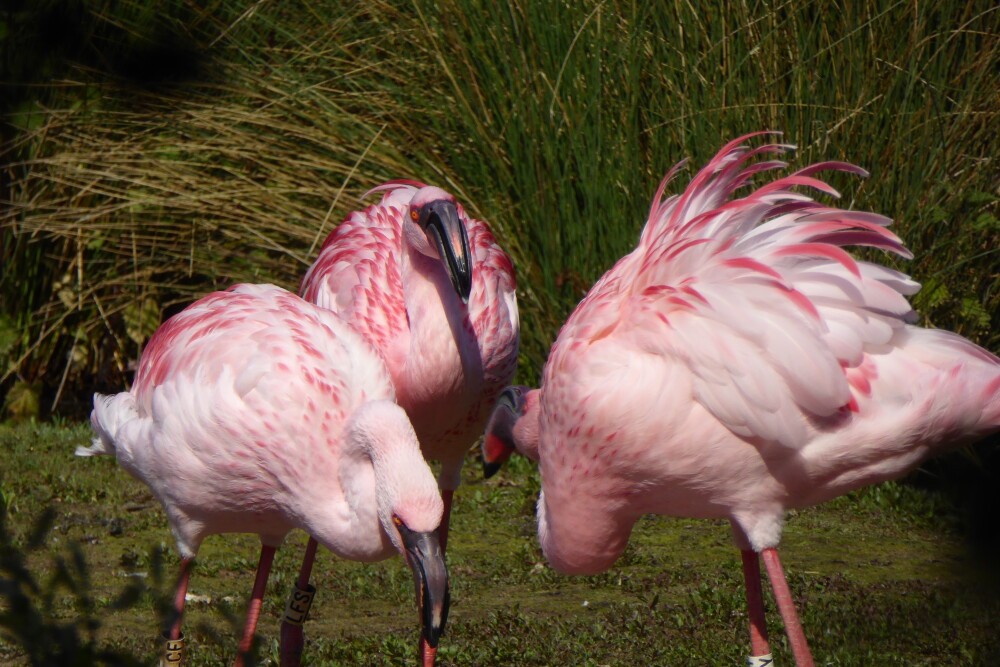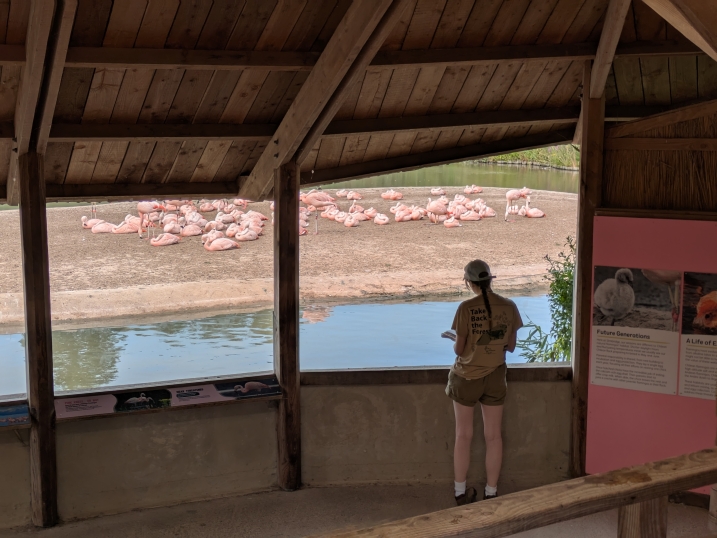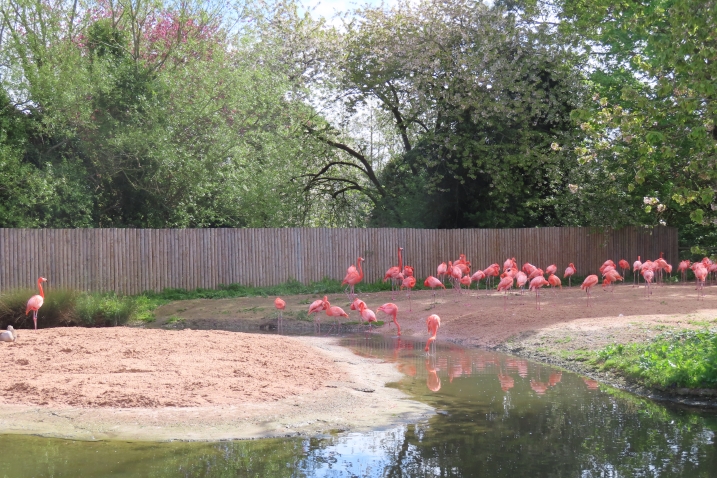
One of the questions I am asked most often when talking about flamingos is whether they have a "partner for life". It's an understandable question given how people often think that many birds pair for life. When we watch a flock of flamingos, we often notice birds standing close together, moving in synchrony, or sharing nesting responsibilities, and it is tempting to interpret these relationships through a human lens. The reality is both simpler and much more fascinating.
My behavioural research on the WWT flamingos has focused on understanding flamingo social behaviour using social network analysis, a technique that allows us to map who spends time with whom and identify the relationships that structure a flock. Because the WWT flamingos have rings on their legs to identify them, and this links to their individual records, we can piece together the background and influences on these relationships too.
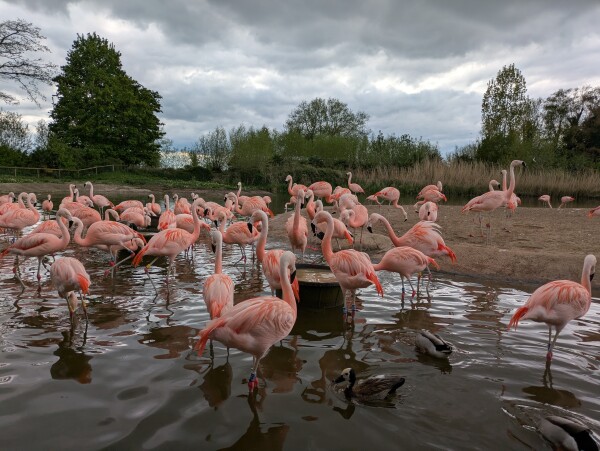
What we've repeatedly found is that flamingo societies are built on a remarkable diversity of social bonds. Some birds form breeding partnerships, of course, but many of the strongest and most consistent relationships we observe occur outside of reproduction altogether.
When people hear the word "relationship", they often immediately think of mating or pair bonding. But animals form relationships for many reasons. Spending time with familiar individuals can reduce conflict, improve access to resources, provide social stability and help animals navigate life in a large group. For flamingos, which naturally live in colonies that can number in the thousands, choosing who to associate with is an important part of daily life.
Using social network analysis, we've been able to show that not all individual flamingos interact randomly within a flock. Instead, they can show clear social preferences. Certain birds consistently choose to spend time together, while others rarely associate. In several long-term studies, we found that these preferred associations remained stable across multiple years, suggesting that these relationships have real social significance for the birds involved.
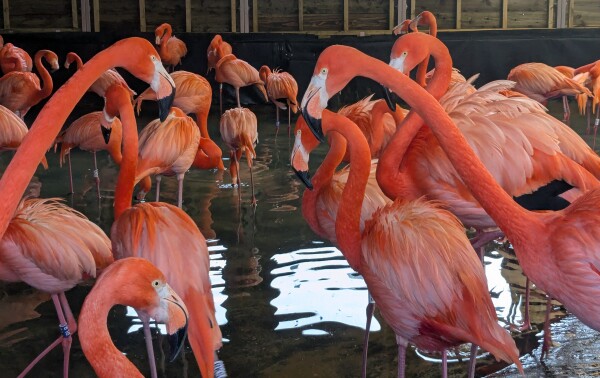
What makes these findings particularly interesting is the variety of relationships that emerge.
Some of the strongest associations are between males and females, which might not be surprising. The energy and time invested in their beautiful pink plumage is there for a reason. To signal to a breeding partner that they are to quality individuals.
However, we also regularly find stable male-male and female-female bonds. In fact, one study following four flamingo flocks over five years found that both male-male and female-female relationships remained stable through time.
We've also observed associations between birds of different ages. Younger flamingos often form social groups with their peers, while older birds can occupy important positions within the wider social network. In some collections, birds seem to act almost as social hubs, connecting different parts of the flock together. These patterns highlight that flamingo society is not organised around breeding pairs alone. Instead, it resembles a complex web of connections involving individuals of different sexes, ages and personalities.
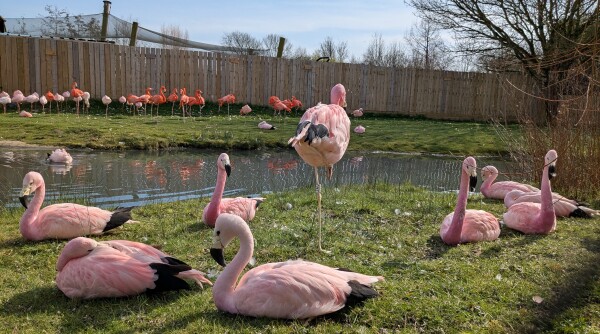
This diversity of social bonds is not restricted to birds living in zoos and wetland centres. Wild flamingos also live in highly structured social groups and this has been noted by scientists working with these birds in the field – there must be some biological value to these social bonds. The challenge in the wild is that following individuals over long periods is much harder than it is in managed populations. By studying flamingos in living collections, where birds can be individually identified and monitored over many years, we gain valuable insights into the social mechanisms that likely underpin flock life more generally.
Of course, whenever we discuss animal relationships, it is important to be careful about the language we use.
Terms such as "friendship", "romance" or "marriage" help us communicate animal behaviour to a wider audience, but they can also be misleading when used without context. We cannot ask flamingos what they think about one another, nor can we assume that their experiences mirror our own. A male flamingo spending years associating with another male flamingo does not necessarily mean the same thing as a human friendship, nor does this mean they are in a romantic relationship. Likewise, a pair of females sharing a nest site should not automatically be interpreted through a human social framework. This same-sex pairing shows how social relationships are diverse, just like they are in humans, but we must ensure we do not become anthropomorphic or put our own terms and meanings on why they exist.
What we can say with confidence is that flamingos make choices about who they spend their time with. Those choices are not determined solely by breeding opportunities. They form stable associations with a range of different individuals, and those associations help shape the structure of the flock.
For me, this is one of the most exciting aspects of flamingo biology. The more we study them, the more we discover that their social lives are far richer than we once imagined. Rather than seeing a flock as a collection of pink birds all behaving in the same way, we can start to recognise it as a community of individuals, each with their own social preferences and connections.
The next time you watch our WWT flamingos, look closely. You may notice birds that always seem to stand together, the individuals that follow one another around their enclosure, or the small groups that repeatedly gather in the same part of the flock. Some of these relationships may be linked to breeding, but many will not be. You may also notice birds that flit between others around them, the highly connected individuals with the network.
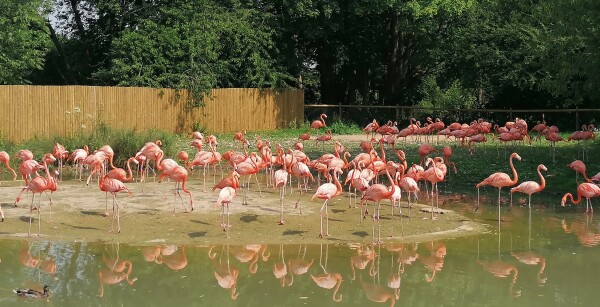
Perhaps the most important lesson flamingos can teach us is that social lives in animals are flexible. Relationships can take many forms, involving individuals of different sexes and ages, and they do not always fit neatly into the categories we might expect. By studying these connections on their own terms, rather than imposing human labels upon them, we gain a much deeper understanding of how animal societies really work.