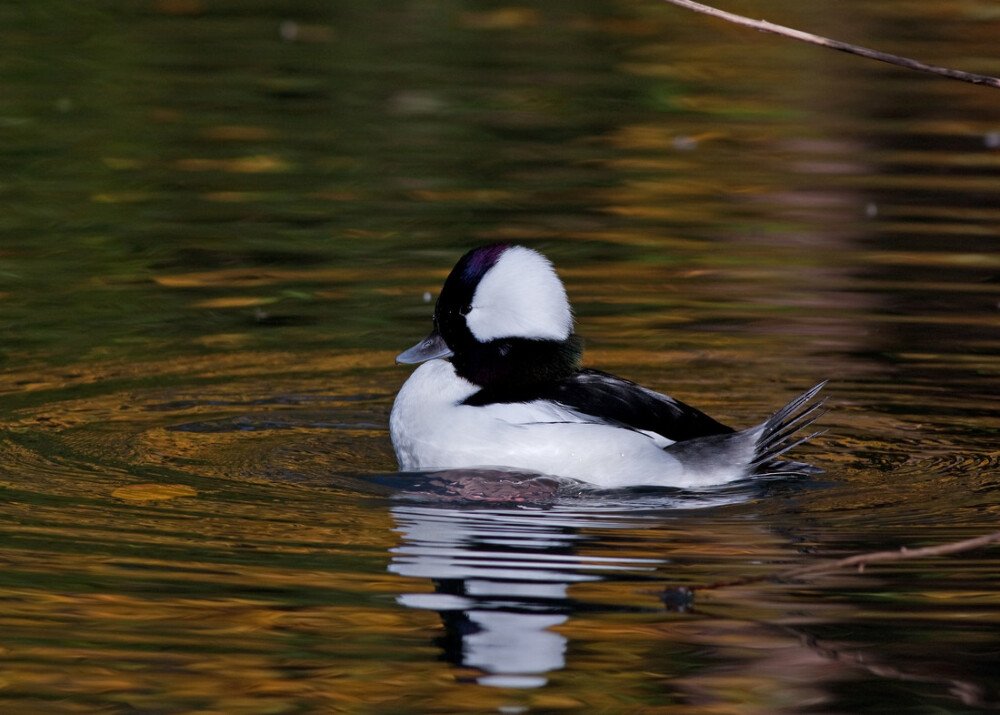
This month, we’re shining a spotlight on one of the smaller members of our Living Collection: the Bufflehead (Bucephala albeola)!
This little diving duck makes a big impact with its striking black-and-white plumage and rounded head. The Bufflehead is a fascinating North American species with some unusual habits.
Where are Buffleheads found in the wild?
Buffleheads are native to North America. They breed mainly across Canada and Alaska, where they favour lakes and ponds surrounded by boreal forests.
During the winter, they migrate to southern North America. They can also be found on inland lakes, ponds and sheltered wetlands.
Interestingly, Buffleheads have also on the rare occasion been recorded much further afield, including in the British Isles!
What do Buffleheads look like?
Buffleheads are one of North America's smallest diving ducks, measuring around 32–40cm in length.
Male Buffleheads are particularly striking, with glossy black plumage contrasting with a large white patch on the side of their head. Depending on the light, their dark head can also show beautiful green and purple colours.
Females are more subtly coloured, with a warm grey-brown body and a distinctive white patch on the cheek.
Their name comes from “buffalo-head”, referring to the male's large, rounded head shape.
What do Buffleheads eat?
Buffleheads are diving ducks, so rather than tipping forward like a dabbling duck, they disappear completely beneath the water when looking for food.
They mainly feed on aquatic invertebrates such as insect larvae, crustaceans, and other small aquatic creatures. Their diet can change depending on where they are feeding, with more aquatic insects eaten in freshwater and more crustaceans taken in coastal waters.
They are surprisingly speedy underwater, with dives usually lasting around 12 seconds before they pop back to the surface!
Where do Buffleheads nest?
Buffleheads have a rather unusual nesting habit for a duck. Instead of building a traditional nest on the ground, they nest inside tree cavities.
They particularly rely on old nesting holes made by Northern Flickers, a species of woodpecker found across North America. Their small size means they can squeeze into cavities that are too small for many other ducks.
Female Buffleheads usually lay around 8–10 eggs, and the ducklings leave the nest just one or two days after hatching, following their mother down to the water.
Are Buffleheads under threat?
Buffleheads are currently classified as Least Concern, and their populations are considered stable overall.
However, like many wetland birds, they still face pressures from habitat loss. The loss of mature forests can reduce the number of suitable nesting cavities available to them, while changes to wetlands and coastal habitats can also affect their feeding areas.
Protecting healthy wetlands and the habitats surrounding them is therefore important for giving these small diving ducks a secure future.
Where can I see Buffleheads at Martin Mere?
Buffleheads are part of the Living Collection at WWT Martin Mere and can be found in our Wooded Wetlands area.
The area was created to showcase species associated with the boreal wetlands of North America, and the Buffleheads' diving behaviour is particularly fascinating to watch.
Inspired to visit?
Come along to WWT Martin Mere and see our Buffleheads for yourself!
WWT Members enjoy unlimited visits all year round, while non-members can save 10% when booking tickets online in advance.
A visit to WWT Martin Mere also helps support our work to protect wetlands and the wildlife that depends on them.